If you’ve started looking into solar for your home, office, or facility in the UAE, you’ve probably run into two terms that get thrown around a lot: EPC and PPA. Vendors use them like everyone already knows the difference, but they describe two genuinely different ways to go solar — different upfront cost, different ownership, different risk.
Get this choice right and solar is one of the better financial decisions a UAE property owner can make, especially with nine-plus months of strong sun and electricity bills that spike hard every summer. Get it wrong — or just default to whichever a salesperson pushes — and you can end up locked into a structure that doesn’t suit your cash flow or your building.
This guide breaks down what solar EPC and a solar PPA actually mean in practice, what each costs, who ends up owning the system, and which one tends to make more sense depending on whether you’re a homeowner, a business, or running a larger commercial or industrial site.
What Is Solar EPC, Exactly?
EPC stands for Engineering, Procurement, and Construction. In plain terms: you own the solar system outright, and one contractor handles the entire job from design through to switch-on.
That single-contractor part matters more than people expect. Solar projects that fall apart usually fall apart at the handoffs — the company that designed the system isn’t the one that sourced the panels, and neither of them is on-site for the installation, so when something doesn’t perform as promised, everyone points at someone else. An EPC contract puts all of that under one roof: system design sized to your actual roof and consumption, sourcing of the panels, inverters, and battery storage, the physical installation, and the utility approvals needed to connect to the grid.
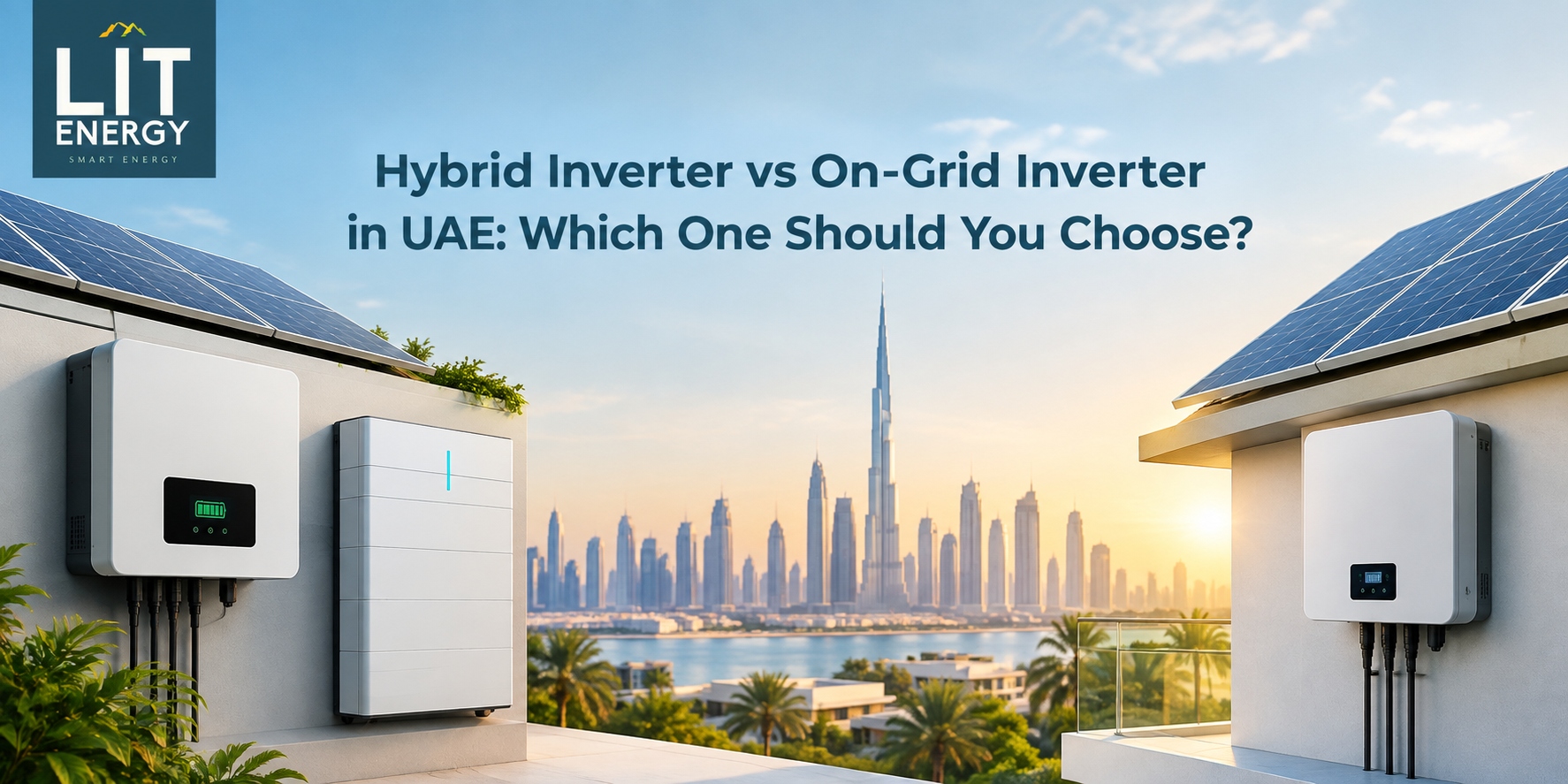
On the hardware side, this is also where the panel and equipment choice actually matters. LIT Energy’s EPC projects are typically built around AIKO ABC back-contact solar panels, which handle high-heat conditions better than standard panel designs — a real factor here, not a marketing line, given how much UAE rooftop temperatures can cut into a conventional panel’s output during summer. Depending on the system, that’s paired with a hybrid inverter and, where backup power or higher self-consumption is the goal, an energy storage system.
With EPC, you pay for the system (in full or through a financing arrangement), you own it from day one, and every riyal — or dirham — of savings from that point forward is yours. You’re also on the hook for maintenance, though most EPC contracts include a warranty and maintenance period to cover that.
What Is a Solar PPA?
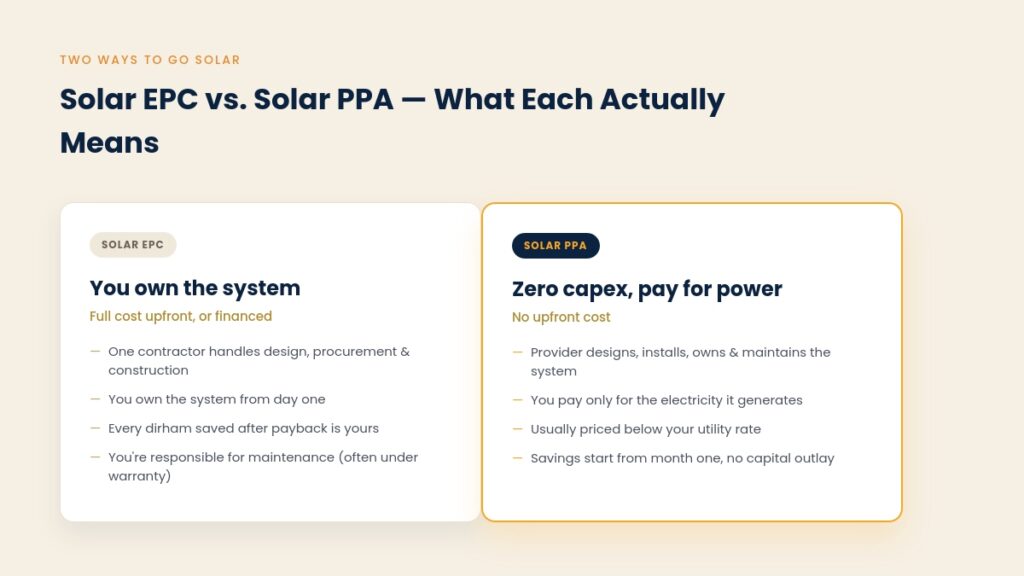
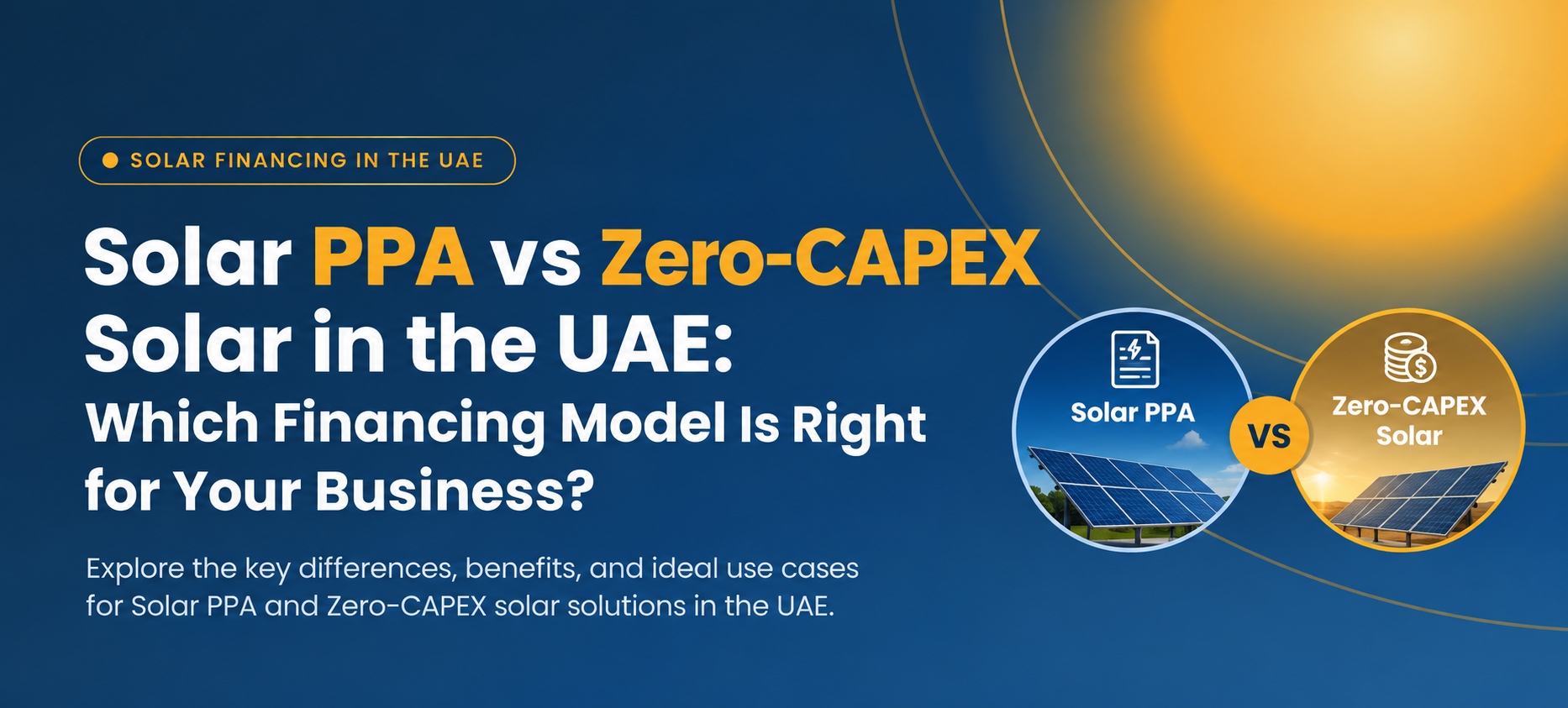
A Power Purchase Agreement flips the model. Instead of buying a solar system, you sign an agreement to buy the electricity it produces — usually at a rate lower than what your utility charges. The provider (in this case, LIT Energy) designs, installs, owns, and maintains the system on your roof or site at no upfront cost to you. You simply pay for the power you use, month to month, for the length of the contract.
This is the structure behind the phrase “zero capex solar” you’ll see used a lot in the UAE market. There’s no large check to write, no capital budget approval needed, and no maintenance to arrange — the provider carries that responsibility because they still own the asset. At the end of the contract term, ownership terms vary by agreement: some PPAs transfer the system to you, others extend or end the arrangement.
For businesses and institutions where capital is better spent elsewhere — inventory, staffing, expansion — a PPA lets you cut electricity costs without touching that budget at all. It’s worth comparing this against other financing options too, since a financed EPC purchase and a PPA solve a similar cash-flow problem in different ways.
The Real Cost Comparison
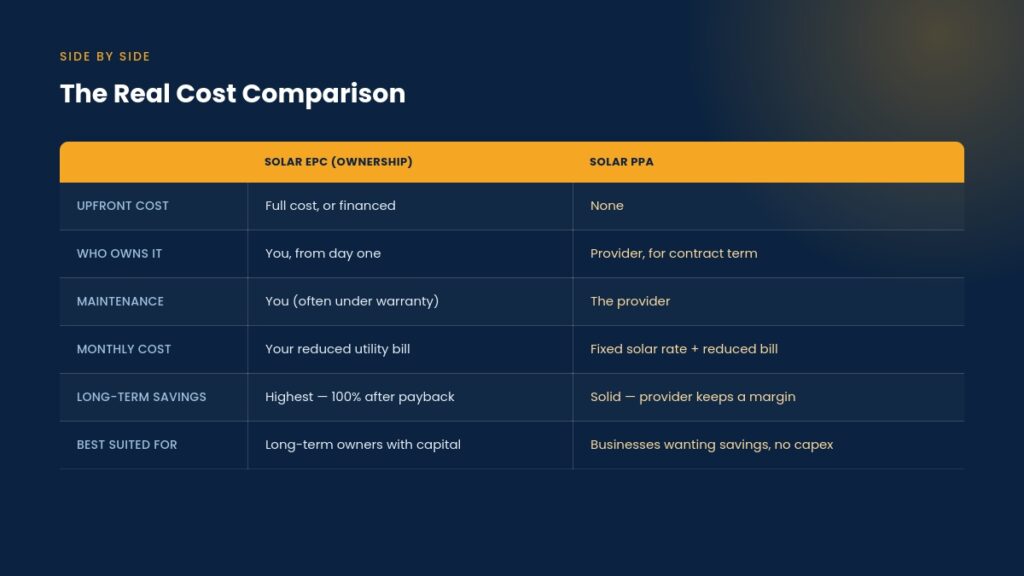
Here’s the structural difference laid out side by side:
| Solar EPC (Ownership) | Solar PPA | |
| Upfront cost | Full cost, or financed | None |
| Who owns the system | You, from day one | The provider, for the contract term |
| Who handles maintenance | You (often under warranty) | The provider |
| Monthly cost | Your reduced utility bill | A fixed solar rate + your reduced utility bill |
| Long-term savings | Highest — you keep 100% of savings after payback | Solid, but the provider keeps a margin |
| Best suited for | Property owners planning to stay long-term, with capital available | Businesses wanting savings without capital outlay |
The honest takeaway: EPC almost always wins on total savings if you have the capital and plan to keep the property for the long run, because once the system pays for itself, every unit of solar power is essentially free. A PPA wins on simplicity and cash flow — you start saving from month one without spending anything, which is exactly why it’s popular with commercial landlords, retail chains, and government facilities that want lower operating costs without a capex line item.
Which One Fits Your Situation?
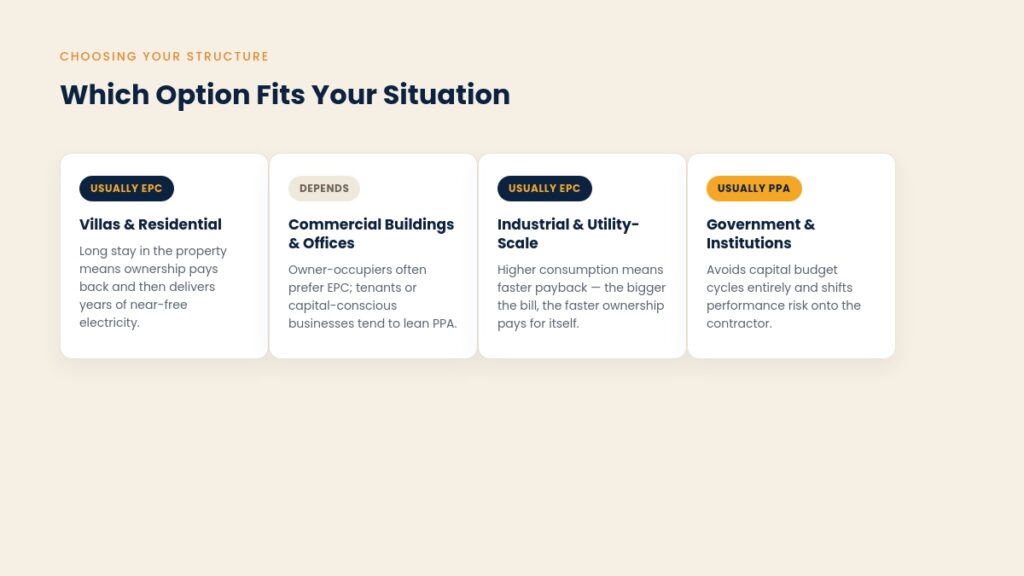
Villas and residential compounds
Most homeowners we work with go the EPC route, often on a system sized around a 5kW hybrid setup for smaller homes or a 10kW system for larger villas. Since you’re likely to stay in the property for years, ownership means the payback period (typically several years, depending on system size and consumption) is followed by a long stretch of near-free electricity. Our residential solar solutions page walks through sizing in more detail.
Commercial buildings and offices
This is where the decision genuinely splits. A business that owns its building and plans to stay put often prefers EPC for the long-term return. A business leasing its space, or one that would rather keep capital free for operations, tends to lean toward PPA. Either way, our commercial solar page covers what a typical office or retail rollout looks like.
Industrial and utility-scale sites
Larger facilities — warehouses, factories, manufacturing plants — usually see the fastest payback under EPC simply because of the scale of their electricity consumption; the bigger the bill, the faster ownership pays for itself. For very large sites, it’s also worth looking at what utility-scale solar involves, since the economics and grid requirements shift again at that size.
Government and institutional buyers
For public-sector and NGO projects, PPA is frequently the more practical route — it avoids capital budget cycles entirely and shifts performance risk onto the contractor, which procurement teams tend to prefer. We’ve supported a range of commercial and institutional projects built around exactly this kind of arrangement.
UAE-Specific Factors That Change the Math
A few things specific to this market are worth factoring in before you decide:
Net metering varies by emirate
DEWA’s Shams Dubai program lets Dubai property owners export surplus solar power back to the grid and receive bill credits. SEWA supports net metering for approved installations in Sharjah, and EtihadWE runs a comparable Distributed Solar System program across Ajman, Umm Al Quwain, Ras Al Khaimah, and Fujairah. The rules, approval process, and export terms differ by utility, so whichever structure you choose, confirm the net metering terms for your specific emirate before signing anything — this affects the real payback math either way.
Summer load changes the calculation
Cooling is by far the largest line item on most UAE electricity bills, and it peaks exactly when solar generation is also at its highest. That overlap is part of why solar pays back faster here than in most other markets — but it also means undersizing a system to save on upfront cost usually backfires, since you’ll still be paying peak summer rates for the shortfall.
Monitoring matters more than people think
Whether you own the system under EPC or you’re on a PPA, being able to see actual generation versus consumption in real time is what catches a shading issue, a soiled panel, or an inverter fault before it quietly eats into your savings for months. Every LIT Energy installation connects to the LitControl app for exactly this reason.
How to Actually Decide
If you’re still weighing it up, these three questions usually settle it:
- Do you have the capital available, and do you plan to own the property for at least 5–7 years? If yes to both, EPC ownership will almost always save you more over time.
- Would freeing up that capital for something else matter more to your business right now than maximizing long-term solar savings? If yes, a PPA is the better fit.
- Are you a government, NGO, or institutional buyer working within a fixed operating budget rather than a capex budget? PPA structures are usually built for exactly this constraint.
There’s no wrong answer here — both structures work, and which one is “better” really depends on your cash position and how long you’re planning to hold the property, not on which one a given vendor prefers to sell.
Frequently Asked Questions
What’s the main difference between solar EPC and a solar PPA in the UAE?
EPC means you pay for and own the solar system outright, handled end-to-end by one contractor. A PPA means a provider installs and owns the system at no cost to you, and you simply pay for the electricity it generates, usually at a lower rate than the grid.
Do I need to pay anything upfront with a PPA?
No. That’s the core appeal — a PPA is typically structured as zero capex, meaning the provider covers design, equipment, and installation, and you start paying only once the system is generating power.
Can I switch from a PPA to ownership later?
It depends on the specific agreement. Some PPA contracts include a buyout option at a set point in the term; others simply renew or conclude. Check this before signing if future ownership matters to you.
Is net metering available across the whole UAE?
Net metering is available in Dubai (via DEWA’s Shams Dubai), Sharjah (via SEWA, for approved installations), and the Northern Emirates (via EtihadWE’s Distributed Solar System program), but the specific terms and application process differ by utility, so it’s worth confirming the details for your emirate before installation.
How long do EPC and PPA contracts typically run?
An EPC project is a one-time build with an ownership warranty period (commonly 10–25 years on panels and shorter terms on inverters and batteries). A PPA is a longer service agreement, typically running for a fixed multi-year term agreed upfront.
Which option is better for a business versus a home?
Homeowners planning to stay long-term usually get more value from EPC ownership. Businesses — particularly those leasing their premises or prioritizing cash flow — often find a PPA a better operational fit. Larger commercial and industrial sites should run the numbers both ways, since consumption size changes the payback timeline significantly.
Still not sure which structure fits your building? Our team can walk through both options against your actual consumption and roof space. Get in touch for a free assessment, or browse our product catalogs and specifications if you’d rather look at the hardware first.