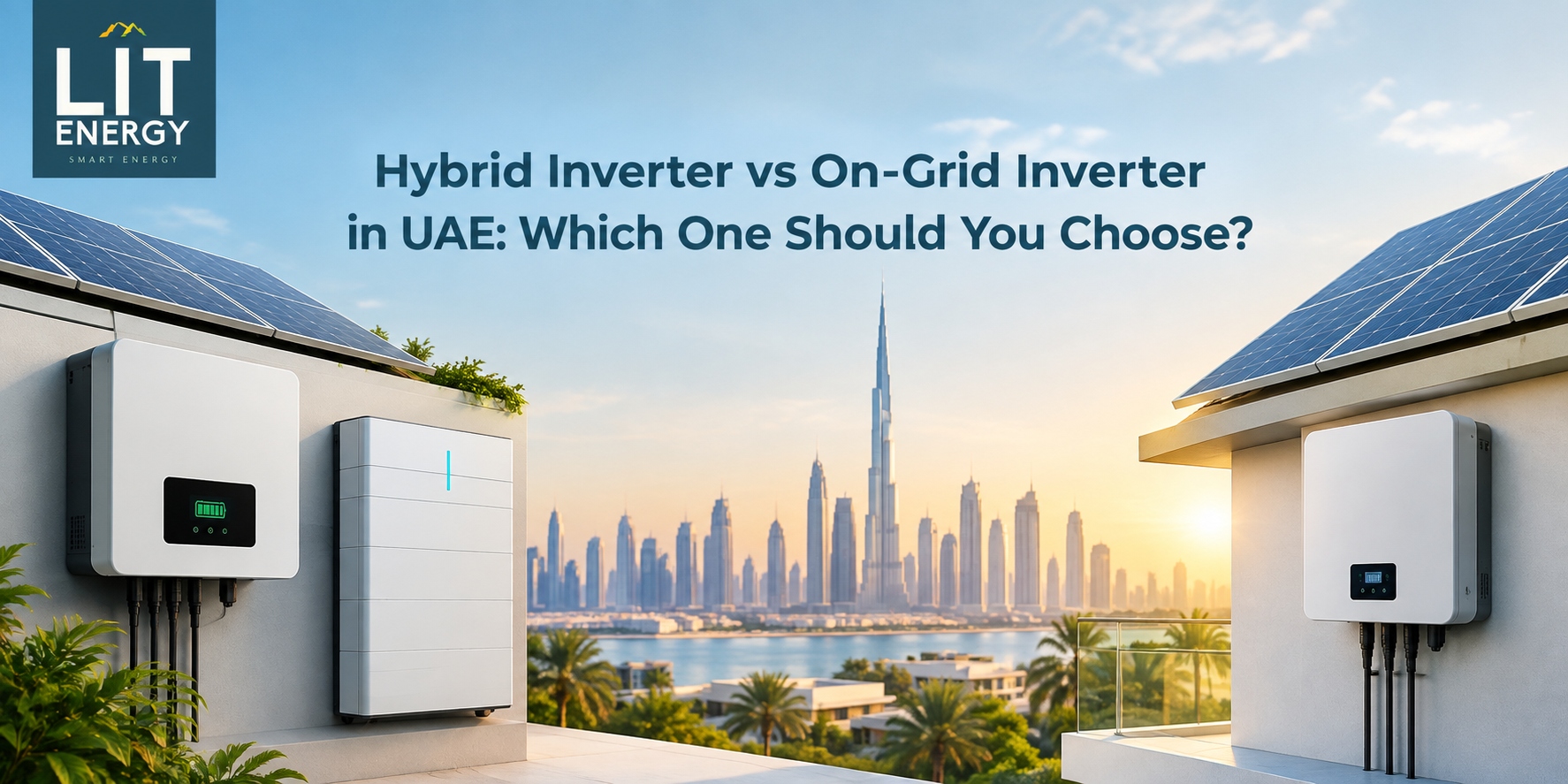
Choosing the right inverter is one of the most important decisions when planning a solar energy system. Solar panels generate electricity in DC form, but most buildings use AC electricity. The inverter converts that solar power into usable electricity and controls how energy moves between the panels, building, battery and grid.
Two of the most common options are hybrid inverters and on-grid inverters. Although both can be part of a solar power system, they are designed for different needs.
For many UAE property owners and businesses, the decision comes down to one question: do you simply want to use solar power and reduce electricity costs, or do you also want battery storage and greater energy flexibility?
This guide explains the difference between hybrid and on-grid inverters, where each option works best, and the factors you should consider before choosing one.
Quick Answer: Hybrid Inverter vs On-Grid Inverter
An on-grid inverter is generally suitable when your solar system is designed to work alongside the electricity grid without battery storage. It can be a straightforward choice for properties focused on using solar generation during operating hours and reducing reliance on grid electricity.
A hybrid inverter is more flexible because it can integrate solar generation with battery storage and, depending on the system design and equipment, provide backup functionality.
If your priority is a simpler grid-connected solar system, an on-grid inverter may be appropriate. If you want battery compatibility, energy storage and greater control over how electricity is used, a hybrid inverter solutions may be the better fit.
What Is an On-Grid Inverter?
An on-grid inverter, also called a grid-tied inverter, connects a solar PV system to the electricity grid.
During the day, solar panels generate electricity. The inverter converts this electricity into AC power that can be used by the building. Depending on the system and applicable utility arrangements, surplus generation may be exported according to the relevant rules.
The main characteristic of an on-grid system is that it is designed to operate with the grid rather than independently from it.
Key characteristics of an on-grid inverter
- Designed for grid-connected solar systems
- Converts DC electricity from solar panels into AC electricity
- Typically used without battery storage
- Helps businesses and property owners use solar generation directly
- Generally has a simpler system configuration than a battery-based hybrid setup
- Suitable for projects where backup power is not the primary requirement
For properties with predictable daytime electricity consumption, an on-grid system can be a practical solution.
What Is a Hybrid Inverter?
A hybrid inverter combines solar power management with battery storage capabilities.
Instead of simply converting solar energy for immediate use, a hybrid system can manage energy from multiple sources. Depending on the configuration, solar electricity can be used by the building, stored in a battery for later use, or supplemented by grid electricity.
This makes hybrid systems particularly useful when energy storage or backup capability is an important part of the project.
Key characteristics of a hybrid inverter
- Supports solar PV systems
- Can integrate compatible battery storage
- Provides greater flexibility in energy management
- Can store excess solar generation for later use
- May support backup loads when correctly designed
- Suitable for systems where future battery integration is important
The exact capabilities depend on the inverter model, battery compatibility, electrical design and installation configuration.
Hybrid Inverter vs On-Grid Inverter: Key Differences
| Feature | Hybrid Inverter | On-Grid Inverter |
| Solar panels | Yes | Yes |
| Grid connection | Yes | Yes |
| Battery compatibility | Usually supported | Generally not the primary function |
| Energy storage | Supported | Not normally included |
| Backup potential | Possible with suitable configuration | Generally not designed for backup |
| System complexity | Higher | Lower |
| Energy management flexibility | Higher | Simpler |
| Typical application | Homes, businesses and projects needing storage | Grid-connected solar projects |
| Future battery integration | Strong option | Usually requires system changes |
The most important difference is not simply the inverter itself. It is how the entire solar system is expected to operate.
Where Are Hybrid Inverters Used?
Hybrid inverters can be useful in situations where electricity needs extend beyond immediate solar generation.
Homes and villas
A homeowner may want to use solar electricity during the day while storing excess generation for later use. A hybrid system can provide the architecture needed for that approach.
Commercial buildings
Businesses may have significant electricity consumption and want more control over when stored energy is used.
Facilities requiring backup
Where maintaining electricity to selected essential loads is important, a properly configured hybrid system can support backup functionality.
Future-ready solar installations
Some property owners may want to install solar now while retaining the ability to add battery storage later. A compatible hybrid inverter can make that pathway easier, subject to the equipment and system design.
Where Are On-Grid Inverters Used?
On-grid inverters are well suited to projects where the primary objective is connecting solar generation to an existing electricity grid.
They can work particularly well when:
- Most electricity is consumed during solar production hours
- Battery storage is not currently required
- The project prioritises a relatively straightforward solar configuration
- The property has a reliable grid connection
- The main objective is increasing direct solar energy consumption
Commercial and industrial properties with substantial daytime loads may find an on-grid configuration attractive, although system sizing should always be based on the property’s actual load profile and project requirements.
Which Inverter Is Better for UAE Conditions?
There is no single inverter that is automatically best for every property in the UAE.
The right choice depends on electricity consumption, operating hours, available roof area, backup requirements, battery plans, grid connection and the overall project design.
The UAE’s climate also makes equipment selection important. Solar equipment operates in high-temperature conditions, so inverter specifications, installation environment, ventilation, protection ratings and manufacturer recommendations should all be considered.
Rather than choosing an inverter based only on its capacity or price, evaluate the complete system.
How to Choose Between a Hybrid and On-Grid Inverter
1. Understand your electricity consumption
Start by looking at how much electricity the property uses and when it uses it.
A building with high daytime consumption may benefit from directly using solar generation. A property with significant evening or backup requirements may have a stronger case for battery storage.
2. Decide whether you need battery storage
If battery storage is not part of your current or future plans, an on-grid inverter may be sufficient.
If storing excess solar energy is important, a hybrid inverter provides a more suitable platform.
3. Consider backup requirements
Ask whether your property needs electricity during grid interruptions.
If backup power is important, investigate a hybrid configuration designed to support essential loads. Do not assume that every hybrid inverter automatically provides whole-building backup.
4. Look at your future requirements
Solar projects are long-term investments. Your energy requirements may change over time.
If you expect to add batteries or change how electricity is managed in the future, selecting equipment with appropriate expansion capabilities can be worthwhile.
5. Check inverter and battery compatibility
Not every battery works with every hybrid inverter.
Before purchasing equipment, verify compatible battery models, voltage ranges, communication protocols, usable capacity and the manufacturer’s installation requirements.
6. Evaluate the complete system, not just the inverter
The inverter is only one component.
A proper assessment should consider:
- Solar panel capacity
- Inverter capacity
- Battery capacity, if applicable
- Electrical loads
- Roof conditions
- Grid connection
- Protection equipment
- Monitoring
- Installation requirements
- Future expansion
For businesses considering different solar configurations, understanding available on-grid solar systems can help establish whether a straightforward grid-connected setup meets the project’s needs.
Common Mistakes to Avoid
Choosing based only on price
The cheapest inverter may not provide the functionality, compatibility or long-term reliability required for the project.
Buying a hybrid inverter without a battery strategy
A hybrid inverter can offer flexibility, but the overall economics depend on how the system will actually be used.
Ignoring the load profile
System design should be based on real electricity consumption rather than simply selecting an inverter based on the size of the solar panels.
Assuming every hybrid inverter provides the same backup
Backup functionality depends on the inverter, battery, wiring configuration, essential-load design and installation.
Focusing only on inverter capacity
A higher kW rating does not automatically mean a better system. The inverter needs to be correctly matched with the PV array, electrical loads and other components.
Ignoring manufacturer compatibility
Battery and inverter compatibility should be confirmed before equipment is purchased.
Best Practices for Selecting a Solar Inverter in the UAE
Start with an energy assessment rather than selecting equipment first.
A professional solar system design should consider your electricity consumption, load profile, solar potential, operating schedule and future energy requirements.
For a hybrid system, pay particular attention to battery compatibility, backup requirements and energy-management capabilities.
For an on-grid system, focus on correct system sizing, grid compatibility, inverter efficiency, monitoring and the expected solar generation profile.
It is also useful to work with a supplier or solar EPC provider that can assess the complete system rather than recommending an inverter in isolation. Lit Energy’s solar EPC offering can be considered as part of a broader project assessment covering solar system design and implementation.
Frequently Asked Questions
Is a hybrid inverter better than an on-grid inverter?
Not necessarily. A hybrid inverter is better suited to projects that need battery storage or greater energy-management flexibility, while an on-grid inverter can be appropriate for straightforward grid-connected solar systems.
Can a hybrid inverter work without batteries?
Some hybrid inverters can operate without batteries, but the exact functionality depends on the specific model. Always check the manufacturer’s specifications before designing the system.
Can an on-grid inverter provide backup power?
A conventional on-grid inverter is generally designed to shut down when the grid goes down for safety reasons. Backup operation requires a system specifically designed and configured for that purpose.
Which inverter is best for a home in the UAE?
It depends on the home’s electricity consumption, daytime usage, backup requirements and whether battery storage is needed. Homes wanting battery storage and greater energy flexibility may consider a hybrid inverter, while homes focused on straightforward grid-connected solar may consider an on-grid system.
Do hybrid inverters work with solar batteries?
Yes, hybrid inverters are designed to work with compatible battery storage systems. However, battery compatibility varies between inverter models, so specifications must be checked before installation.
How do I choose the right inverter size?
Inverter sizing should consider the solar panel capacity, expected electricity production, building load, operating patterns, system configuration and manufacturer specifications. A professional system assessment is preferable to choosing an inverter based solely on panel capacity.
Conclusion
Choosing between a hybrid inverter and an on-grid inverter depends on what you want your solar system to achieve.
An on-grid inverter can be a practical choice for a grid-connected solar installation focused on using solar electricity directly. A hybrid inverter offers greater flexibility when battery storage, energy management or backup capability is part of the plan.
The best approach is to evaluate your electricity consumption, load profile, future requirements and budget before selecting the equipment. A properly designed system can help ensure that the inverter, solar panels, battery and electrical infrastructure work together efficiently.
For UAE homes and businesses considering solar, Lit Energy can help assess the wider system requirements and determine which solar configuration is appropriate for the project.