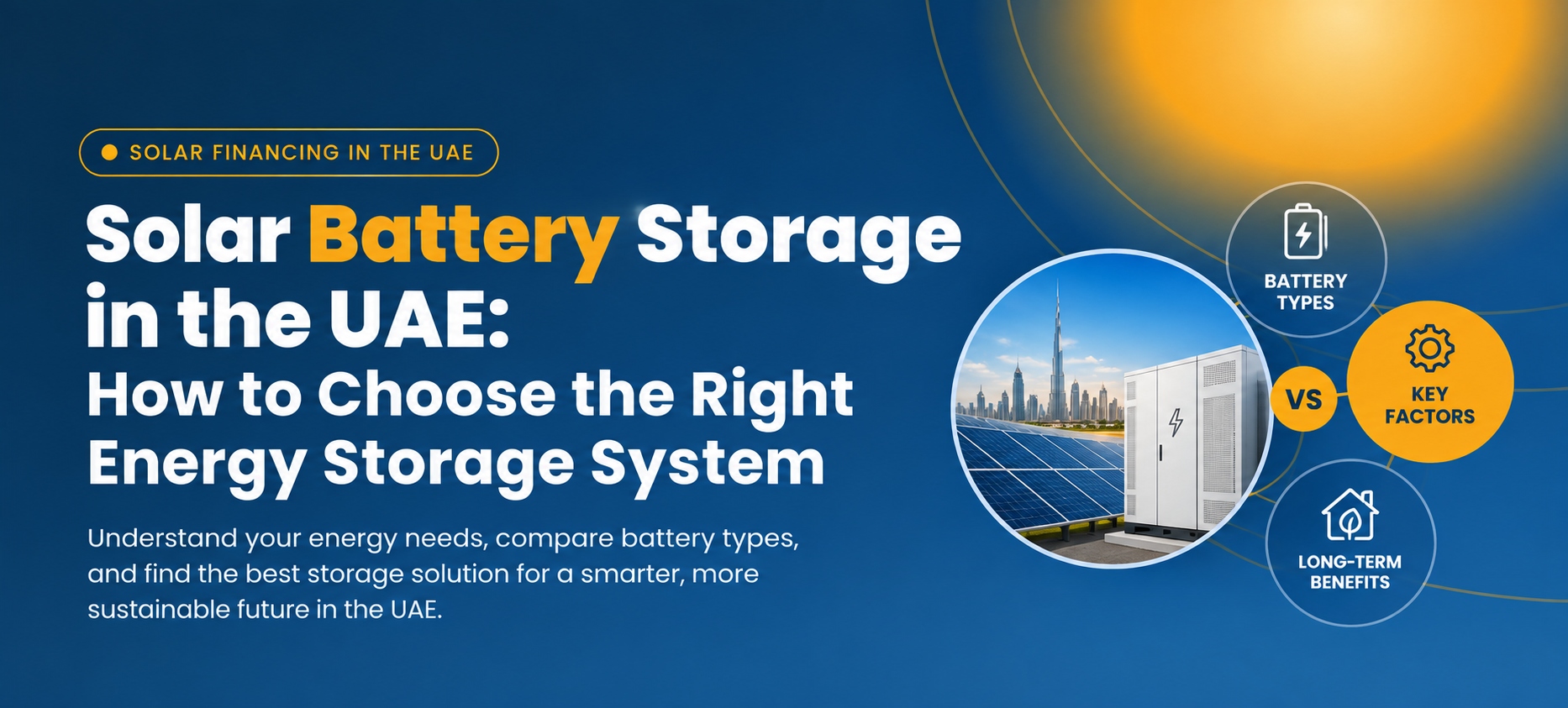
Solar panels generate electricity when the sun is available, but businesses do not always consume energy at the same time that solar production is highest. This is one reason battery storage has become an important part of modern solar system planning.
A suitable energy storage system can store available energy for later use, provide backup capacity where the system is designed for it, and help businesses manage when they consume solar-generated electricity.
However, choosing a battery is not simply a matter of finding the largest capacity or searching for a “10kWh solar battery price UAE” and selecting the lowest figure.
You also need to consider battery chemistry, usable capacity, power rating, depth of discharge, inverter compatibility, operating environment, safety features, lifecycle, installation requirements, and future expansion.
For businesses looking for an energy storage system supplier in the UAE, understanding these factors makes it easier to compare systems based on their actual requirements.
What Is a Solar Energy Storage System?
A solar energy storage system stores electrical energy so it can be used later.
In a typical solar-plus-storage configuration, solar panels generate electricity during daylight hours. Depending on the system design and current demand, electricity can be used directly by the property, stored in the battery, or supplied through the grid.
Later, stored energy can be used when solar production is lower.
The exact operating behavior depends on the inverter, battery management system, controls, grid connection, and system configuration.
Battery storage can therefore serve several different purposes, including:
- Storing excess solar generation
- Supporting energy use outside solar production hours
- Providing backup power where supported by the system
- Increasing the use of self-generated solar energy
- Supporting commercial or industrial energy-management strategies
- Providing scalable storage for larger energy projects
The right application determines what type and size of battery system is appropriate.
Why Battery Capacity Alone Is Not Enough
One of the most common mistakes in battery selection is focusing only on the advertised kWh figure.
A battery’s nominal capacity tells you how much energy the battery is designed to store under specified conditions, but the amount of energy that can actually be used depends on factors such as depth of discharge and system operating limits.
For example, LIT Energy’s Hi-241H Industrial LiFePO4 Energy Storage System is listed with 241.2 kWh of total system energy and 217.08 kWh of usable energy based on its specified 90% depth of discharge.
This illustrates why buyers should compare usable energy as well as nominal capacity.
When comparing battery systems, ask:
- What is the total rated capacity?
- What is the usable capacity?
- What depth of discharge is specified?
- What output power can the system provide?
- What are the charging and discharging limits?
- What operating conditions apply?
What Is LiFePO4 Battery Technology?
LiFePO4 stands for Lithium Iron Phosphate.
It is a lithium battery chemistry used in energy storage applications. Battery chemistry matters because it affects characteristics such as thermal behavior, cycle performance, energy density, system design, and operating requirements.
For commercial and industrial applications, LiFePO4 systems can be used as part of larger energy storage installations.
The Hi-241H listed by LIT Energy, for example, uses Lithium Iron Phosphate cells and is positioned for commercial and industrial applications. Its published specifications include a 314Ah cell capacity, 90% depth of discharge, and a 241.2 kWh total system energy rating.
Businesses evaluating lithium battery storage in the UAE should still compare the complete system rather than selecting a battery chemistry in isolation.
How Much Battery Capacity Does a Business Need?
There is no single battery size that is suitable for every business.
A battery should be sized according to the property’s electricity profile and the purpose of the storage system.
Start by identifying:
Daily electricity consumption
Review actual electricity usage rather than estimating from the building’s size.
Solar generation
Determine how much energy the solar system is expected to produce and when that energy is generated.
Daytime load
If the business consumes most of its electricity during solar production hours, the value of additional storage may be different from a site with significant evening or overnight demand.
Required backup loads
If backup power is part of the objective, identify which equipment must remain operational.
Critical loads may include selected lighting, communications equipment, security systems, refrigeration, IT infrastructure, or specific industrial equipment, depending on the business.
Desired backup duration
A system designed for short-duration backup has different requirements from one intended to support selected loads for several hours.
Future expansion
Businesses expecting higher electricity demand may want a storage architecture that can be expanded later.
What Does a 10kWh Solar Battery Mean?
A 10kWh battery is often searched for by homeowners and smaller commercial users, but the capacity number alone does not tell you whether the system is appropriate.
A 10kWh battery refers broadly to a battery with approximately 10 kWh of rated energy capacity. Actual usable energy depends on the battery’s operating limits and specified depth of discharge.
The search for “10kWh solar battery price UAE” also needs context because battery pricing can vary based on:
- Battery chemistry
- Brand and model
- Usable capacity
- Inverter compatibility
- Battery management system
- Installation requirements
- Protection equipment
- Communication features
- Warranty terms
- Number of battery modules
- Project scale
For this reason, businesses should compare complete system specifications rather than using a single online price as the basis for procurement.
Commercial and Industrial Storage Requires a Different Approach
A small battery for a home or light commercial application is very different from a large industrial energy storage system.
Commercial and industrial sites may require higher voltage, greater energy capacity, higher discharge power, advanced battery management, multiple inverter connections, and more robust environmental protection.
LIT Energy’s Hi-241H is one example of a larger system listed for commercial and industrial applications. Its published configuration consists of 15 battery modules, with a total system energy rating of 241.2 kWh and a nominal system voltage of 768V.
The system is also listed with compatibility for Solis, Deye, Growatt, ATESS, and Megarevo inverters.
This type of specification matters when a business is assessing battery and inverter compatibility during system design.
Check Inverter Compatibility Before Buying
A battery should not be selected independently from the inverter.
The inverter needs to support the battery’s electrical characteristics and communication requirements. The final system may also require compatible battery management and monitoring interfaces.
This becomes particularly important when adding batteries to an existing solar installation.
Before purchasing, confirm:
- Battery voltage range
- Maximum charge current
- Maximum discharge current
- Communication protocol
- Supported inverter models
- Number of battery modules supported
- System expansion limitations
- Required protection equipment
Businesses researching system architecture can also review LIT Energy’s guide to hybrid vs on-grid inverters because the inverter configuration influences how solar generation, battery storage, and grid electricity interact.
Consider UAE Operating Conditions
Battery systems installed in the UAE need to be selected with the local operating environment in mind.
High ambient temperatures can affect equipment performance and may require appropriate thermal management, installation conditions, ventilation, and system derating.
For example, the Hi-241H is specified for operation from -20°C to 50°C, with derating above 45°C. It also has an IP54-rated enclosure and C3-grade anti-corrosion coating according to LIT Energy’s published specifications.
These details demonstrate why buyers should look beyond capacity when comparing lithium battery storage UAE options.
The correct system needs to match the installation environment as well as the energy requirement.
Battery Power Rating Matters Too
Two batteries can have similar energy capacity but very different power capabilities.
Energy capacity is commonly measured in kWh, while power output is measured in kW.
For example, a battery may store a certain amount of energy but have a maximum discharge rate that limits how much equipment can run simultaneously.
Businesses should therefore identify the expected peak load and critical loads before choosing a storage system.
For industrial applications, starting currents and high-demand equipment may make power capability just as important as total stored energy.
Cycle Life and Depth of Discharge
Cycle life is another important comparison point.
Battery manufacturers may specify cycle life under particular test conditions. These conditions can include temperature, charge/discharge rate, and end-of-life criteria.
LIT Energy lists the Hi-241H with a cycle life of at least 6,000 cycles under its stated test conditions and a 90% depth of discharge.
When comparing systems, always review the conditions behind a cycle-life figure rather than treating the number as a universal prediction of real-world service life.
How Solar Panels and Batteries Work Together
Battery storage is only one part of the solar system.
The panels determine how much electricity can be generated, while the inverter controls the conversion and system operation. The battery stores energy for later use.
The quality and configuration of the solar generation system therefore remain important.
Businesses evaluating PV equipment can also review LIT Energy’s article about AIKO ABC solar panel technology when considering the relationship between solar generation and storage capacity.
The goal is to size the entire system as one energy solution rather than choosing each component independently.
Battery Storage for Larger Solar Projects
As solar installations become larger, energy storage can also become part of a broader energy infrastructure strategy.
LIT Energy presents solar solutions across commercial, industrial, and larger-scale applications. Its website also discusses a 10 MW solar system as part of its broader solar project content.
For businesses evaluating larger projects, the battery system may need to be considered alongside solar capacity, inverter architecture, energy-management controls, grid requirements, and the site’s operating profile.
Readers researching larger solar installations can explore LIT Energy’s discussion of its 10 MW solar system for additional project context.
Common Battery Storage Buying Mistakes
Businesses can avoid many procurement problems by reviewing the complete specification before ordering.
Common mistakes include:
- Choosing capacity without checking usable energy
- Ignoring peak power requirements
- Buying a battery without confirming inverter compatibility
- Focusing only on the advertised price
- Ignoring operating-temperature requirements
- Not checking protection and enclosure ratings
- Comparing cycle-life numbers without reviewing test conditions
- Selecting a system that cannot accommodate future expansion
- Treating a residential battery and industrial ESS as interchangeable
- Failing to define which loads need backup power
A properly designed energy storage system should be based on actual electricity usage, solar production, operating conditions, and future requirements.
How to Compare an Energy Storage System Supplier in the UAE
When comparing suppliers, look at more than the product catalogue.
A useful evaluation can include:
Technical suitability: Does the system match your voltage, power, capacity, and inverter requirements?
Battery chemistry: Is the chemistry appropriate for the intended application?
Environmental suitability: Can the system operate under the site’s temperature and installation conditions?
Scalability: Can additional storage be added later if required?
Compatibility: Does the battery communicate correctly with the selected inverter and control system?
Documentation: Are detailed specifications, certifications, and operating limits available?
Project support: Can the supplier support system design and integration requirements?
These questions can help businesses compare complete solutions rather than individual battery prices.
Quick Answer
How do you choose the right solar battery storage system in the UAE?
Choose a battery based on usable capacity, required power output, solar generation, electricity consumption, backup requirements, battery chemistry, inverter compatibility, operating temperature, cycle-life specifications, safety features, and future expansion needs. The right size depends on the actual energy profile of the property, not simply on a preferred kWh number.
FAQs
Question 1: What is the best battery chemistry for solar storage?
The appropriate chemistry depends on the application. LiFePO4, or lithium iron phosphate, is one battery chemistry used in solar and energy-storage systems. Buyers should compare chemistry, capacity, power, operating conditions, lifecycle, safety features, and compatibility.
Question 2: What does a 10kWh solar battery mean?
A 10kWh battery generally refers to a system with approximately 10 kWh of rated energy capacity. The usable energy can be lower depending on the battery’s specified depth of discharge and operating limits.
Question 3: How much does a 10kWh solar battery cost in the UAE?
There is no single price because the cost depends on battery chemistry, brand, model, usable capacity, inverter compatibility, installation requirements, warranty, and other system components. A complete system quotation provides a more meaningful comparison than the battery capacity alone.
Question 4: Is LiFePO4 suitable for commercial energy storage?
LiFePO4 is used in commercial and industrial energy-storage applications. Suitability still depends on the required capacity, power, operating environment, inverter compatibility, and system design.
Question 5: How do I know what battery size my business needs?
Review electricity consumption, solar production, daytime and nighttime loads, required backup loads, desired backup duration, and future energy demand. These factors can then be used to determine an appropriate storage capacity and power rating.
Question 6: Can a battery be added to an existing solar system?
It is possible, but compatibility must be checked. The existing inverter, battery voltage range, communication system, electrical configuration, and available space all need to be reviewed before adding storage.
Conclusion
Choosing solar battery storage in the UAE requires more than comparing kWh capacity or searching for the lowest 10kWh solar battery price.
Businesses should evaluate usable energy, power output, battery chemistry, depth of discharge, cycle-life specifications, inverter compatibility, operating temperature, enclosure protection, scalability, and the actual purpose of the storage system.
For smaller applications, a compact lithium storage system may be sufficient. Commercial and industrial facilities can require substantially larger systems with higher voltage, greater capacity, and more advanced integration requirements.
LIT Energy LLC lists lithium-based energy storage solutions ranging from smaller integrated systems to commercial and industrial configurations such as the Hi-241H.
The most practical approach is to size the battery around the site’s real energy profile and then select compatible solar, inverter, and storage components as one coordinated system.