Choosing a solar EPC contractor in the UAE is a significant decision for any business planning to invest in solar energy. The right partner can help you assess your property’s potential, select suitable equipment, coordinate project requirements, and plan a solar installation that aligns with your operational needs and budget. The wrong choice, however, can leave you dealing with unclear costs, unsuitable equipment, project delays, or unexpected maintenance responsibilities.
For commercial buildings, warehouses, factories, and other large facilities, selecting a contractor involves more than comparing solar panel prices. You need to understand the company’s engineering capabilities, procurement process, project management approach, technical documentation, and support arrangements after commissioning.
Whether you are considering rooftop solar, an industrial solar power system, or a larger renewable energy project, asking the right questions before signing a contract can make the decision much clearer.
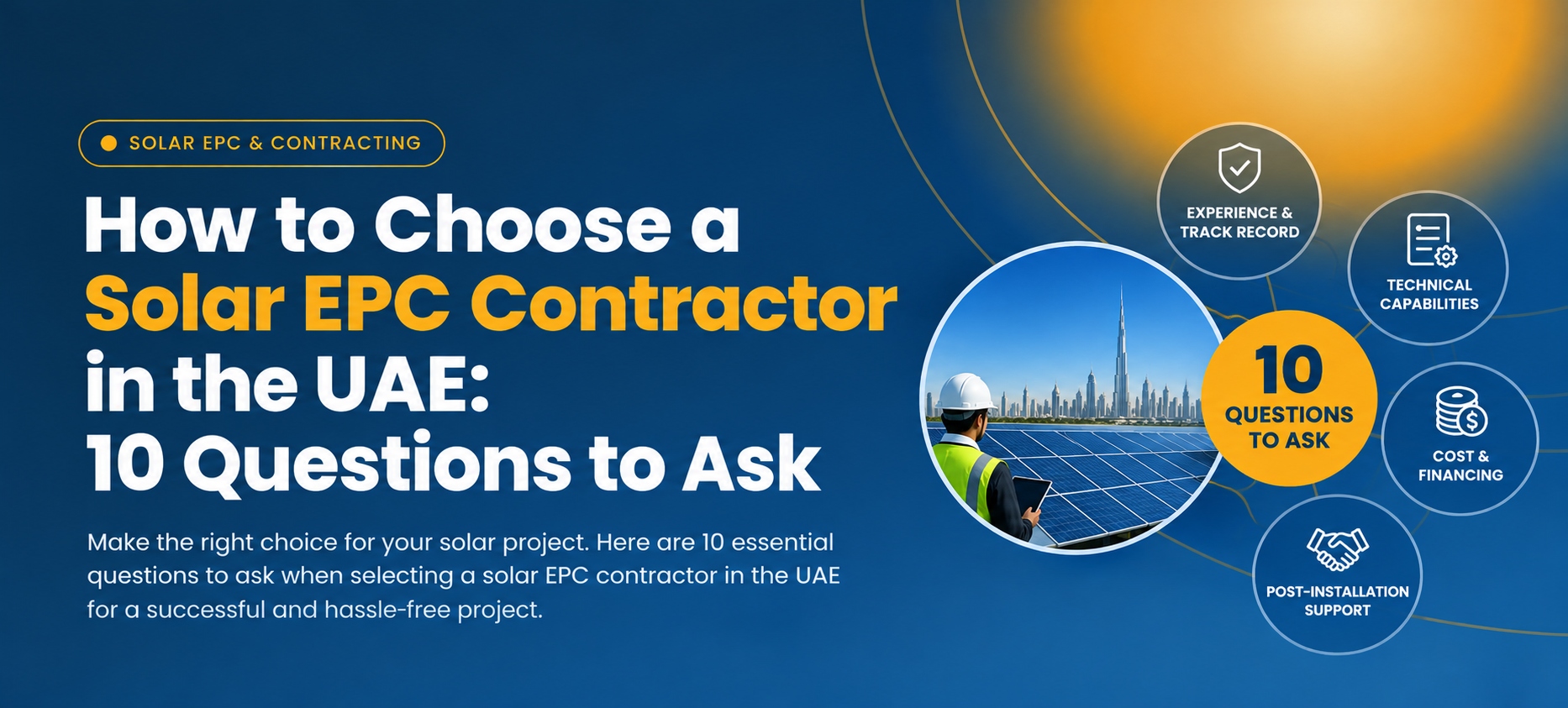
Here are ten essential questions to ask when evaluating a solar EPC contractor in the UAE.
What Does a Solar EPC Contractor Do?
EPC stands for Engineering, Procurement, and Construction. A solar EPC contractor coordinates the major stages of a solar project, from technical planning and equipment selection to installation, testing, and commissioning, depending on the agreed scope of work.
A typical project may involve:
- Engineering: Assessing electricity consumption, evaluating the installation site, developing the system design, and preparing technical documentation.
- Procurement: Selecting solar panels, inverters, mounting structures, cables, protection equipment, and energy storage components where required.
- Construction: Managing installation, electrical integration, site coordination, and other agreed construction activities.
- Testing and commissioning: Checking system operation, verifying electrical connections, and completing handover documentation.
The exact responsibilities vary by contract. Some providers coordinate the complete project, while others subcontract particular activities or exclude certain services.
Before comparing proposals from a solar engineering company in the UAE, establish precisely what each contractor will deliver.
10 Questions to Ask Before Hiring a Solar EPC Contractor in the UAE
1. What Is Included in Your Solar EPC Scope of Work?
Start by asking the contractor to explain the complete project scope in writing.
A quotation may include solar panel supply and installation but exclude structural assessments, electrical upgrades, utility coordination, monitoring equipment, or long-term maintenance. Two proposals can therefore have very different prices while appearing similar at first glance.
Ask for a detailed breakdown covering:
- Site assessment and feasibility evaluation.
- Solar system design and engineering documentation.
- Equipment supply and procurement.
- Mounting structures and installation.
- Electrical protection and grid integration, where applicable.
- Required approvals and technical documentation.
- Testing, commissioning, and system handover.
- Warranty coordination and after-sales support.
Also clarify which activities are subcontracted and who remains accountable for coordinating them.
What to look for: A clearly defined scope with deliverables, exclusions, responsibilities, and acceptance criteria. Avoid relying on verbal assurances when important project responsibilities should be documented.
2. How Will You Assess Whether My Property Is Suitable for Solar?
A reliable proposal should be based on your property’s actual conditions rather than a standard system size.
For a commercial solar installation in the UAE, the contractor should understand your electricity consumption, available roof or land area, operating schedule, and existing electrical infrastructure.
The assessment may include:
- Historical electricity bills and consumption data.
- Roof dimensions, orientation, shading, and usable space.
- Structural suitability and potential loading restrictions.
- Existing electrical systems and connection requirements.
- Expected daytime energy consumption.
- Future changes in facility operations or electricity demand.
For industrial facilities, the assessment should also consider high-demand equipment, production schedules, and operational constraints during installation.
Ask how the contractor will translate these findings into a proposed system capacity and expected energy generation.
What to look for: A site-specific feasibility assessment with clearly stated assumptions. A proposal based only on roof size or a quick visual inspection may not provide enough information for a sound investment decision.
3. What Experience Do You Have With Similar Solar Projects?
Experience should be relevant to your project, not simply measured by the number of installations a company claims to have completed.
A contractor experienced in small residential systems may approach a large warehouse or manufacturing facility differently from a company accustomed to commercial and industrial projects.
Ask for examples involving similar:
- Property types and installation environments.
- Solar system capacities.
- Electrical infrastructure and grid requirements.
- Energy consumption patterns.
- Project timelines and operational restrictions.
Where possible, request references, project documentation, or permission to speak with previous clients. Ask how challenges such as restricted installation access, structural limitations, or commissioning delays were managed.
If the contractor presents performance figures or financial savings from earlier projects, ask what assumptions and measurement periods support those figures.
What to look for: Relevant, verifiable project experience and a realistic explanation of how that experience applies to your facility. Do not rely solely on marketing photographs or unsubstantiated claims.
4. Which Solar Panels, Inverters, and Other Components Will You Use?
The equipment selected for a solar project affects system performance, compatibility, maintenance requirements, and long-term operating costs.
Ask the contractor to identify the proposed manufacturers and models rather than referring only to generic categories such as high-efficiency panels or advanced inverters.
Your equipment review should cover:
- Solar panel specifications and applicable product warranties.
- Inverter capacity, operating characteristics, and compatibility.
- Mounting structures suitable for the installation environment.
- Electrical protection and monitoring equipment.
- Battery storage specifications, if energy storage is required.
- Equipment availability, replacement options, and warranty procedures.
For example, a project that includes a high-voltage three-phase hybrid inverter may require a different technical assessment from a conventional grid-connected system. The components must be selected to work together within the proposed system design.
You can review the ITHV-H3P three-phase high-voltage hybrid inverter from LIT Energy as an example of the type of product-level information that can help buyers examine inverter specifications.
Ask the contractor to explain why each proposed component suits your project and whether alternative models would affect the design, price, warranty, or expected output.
What to look for: A documented bill of materials, technical datasheets, compatibility information, and clearly identified warranties. Avoid accepting substitutions without reviewing their technical and commercial implications.
5. Who Will Handle Approvals and Utility Coordination?
Solar projects in the UAE may require approvals, technical submissions, inspections, or coordination with the relevant electricity utility and other authorities. The applicable process depends on the emirate, project type, system configuration, and connection arrangements.
For example, projects may involve Dubai Electricity and Water Authority (DEWA) or the relevant authority in Abu Dhabi, depending on the project location.
Ask the contractor:
- Which approvals and submissions apply to my project?
- Who will prepare and submit the technical documentation?
- Who will coordinate inspections and respond to authority comments?
- Are approval-related fees included in the quotation?
- What happens if the proposed design requires changes?
- Can construction begin before particular approvals are obtained?
Request a written responsibility matrix showing which tasks belong to the contractor, property owner, consultant, utility, or other parties.
Do not assume that every EPC contract automatically includes all approvals or guarantees a particular approval timeline.
What to look for: A clear approval plan that identifies the responsible parties, required documentation, dependencies, and any excluded fees.
6. How Will You Manage Project Timelines and Site Disruption?
For commercial and industrial properties, installation work must fit around business operations. Delays or poorly coordinated site activities can affect production, warehouse access, staff movement, or other facility functions.
Ask the contractor to provide a project schedule covering:
- Initial assessment and design.
- Technical reviews and approval dependencies.
- Equipment procurement and delivery.
- Site preparation and installation.
- Electrical integration and testing.
- Commissioning and handover.
Discuss what could affect the schedule, including equipment lead times, approval delays, weather, access restrictions, and unexpected site conditions.
If your facility operates continuously, ask how installation activities will be planned to limit disruption. Clarify whether any shutdowns or interruptions to the existing electrical supply may be necessary.
The contract should also explain how schedule changes will be communicated and who is responsible for resolving delays within their control.
What to look for: A realistic schedule with milestones, dependencies, reporting arrangements, and a documented process for managing variations.
7. What Will the Complete Project Cost?
The initial quotation is only one part of the financial assessment. You need to understand the full cost of delivering and operating the system.
Ask for an itemised quotation covering equipment, engineering, installation, electrical work, approvals where included, testing, commissioning, and handover.
Check whether the price includes:
- Structural reinforcement, if required.
- Electrical upgrades or distribution equipment.
- Scaffolding, lifting equipment, and site access arrangements.
- Monitoring hardware and software.
- Transport and equipment handling.
- Taxes, applicable fees, and other charges.
- Maintenance and monitoring services, if offered.
Request details of payment milestones, advance payments, retention arrangements, and the process for approving additional costs.
It is also worth comparing the financial assumptions used to estimate electricity savings. These should reflect the proposed system’s expected generation, the proportion of solar electricity your facility can use, applicable tariffs, operating costs, and any relevant export arrangements.
What to look for: A transparent total project cost, documented exclusions, and realistic financial assumptions. The lowest quotation may not represent the lowest overall cost of ownership.
8. Can You Explain the Expected Energy Generation and Financial Return?
A solar contractor should be able to explain how the proposed system is expected to perform and what assumptions support the forecast.
Ask for a projected energy-generation estimate based on the site, system capacity, equipment specifications, shading, orientation, and other relevant design factors.
The proposal should distinguish between expected generation and actual electricity bill savings. A system may generate electricity when your facility has limited demand, while other consumption patterns may allow you to use a larger share of the solar energy directly.
Request clarification on:
- Expected annual energy generation.
- The assumptions behind the forecast.
- Expected system losses and performance degradation.
- Estimated self-consumption and any export assumptions.
- Electricity tariff assumptions.
- Estimated operating and maintenance expenses.
- The method used to calculate payback or return on investment.
If the contractor provides a payback period, ask for the calculation and test how the result changes under less favourable assumptions.
For example, lower-than-expected generation, a change in electricity consumption, or higher maintenance costs may affect the financial outcome.
No forecast should be treated as a guaranteed saving unless a specific contractual arrangement clearly defines the applicable performance obligations and conditions.
What to look for: A transparent technical and financial model that you can review, compare, and challenge.
9. What Warranties, Maintenance, and After-Sales Support Are Included?
A solar installation is a long-term asset, so the support arrangements matter well beyond commissioning.
Ask the contractor to distinguish between product warranties, installation workmanship warranties, and any system-performance commitments.
Find out:
- Who handles warranty claims with equipment manufacturers?
- What are the warranty periods and exclusions?
- Is preventive maintenance available, and at what cost?
- How are faults reported and diagnosed?
- Is remote monitoring included?
- Who investigates reduced energy generation?
- What response times are offered, if any?
- Are replacement parts and technical support available locally?
If monitoring is included, clarify which system data you can access, who reviews alerts, and whether monitoring is passive or supported by an agreed maintenance service.
Also ask what documentation you will receive at handover, including equipment manuals, electrical drawings, commissioning reports, warranty details, and maintenance instructions.
What to look for: A written support plan with clear responsibilities, service inclusions, response arrangements, and warranty procedures. Avoid assuming that a manufacturer’s warranty automatically covers labour, travel, or system downtime.
10. Can the System Support Future Expansion or Energy Storage?
Your electricity needs may change as your business grows, adds equipment, extends operating hours, or adopts new technologies.
Ask whether the proposed solar system can accommodate future expansion and what changes would be required.
Consider:
- Available roof or land area for additional panels.
- Inverter capacity and compatibility.
- Electrical infrastructure limitations.
- Opportunities to integrate battery storage.
- Monitoring and energy management capabilities.
- Future load growth and changes in consumption patterns.
If battery storage is under consideration, ask the contractor to explain its intended purpose. Storage may support backup requirements, shift energy use to other periods, or help manage specific operational needs, depending on system design and applicable rules.
However, a battery does not automatically make a solar system suitable for every backup requirement. Its usable capacity, discharge power, operating configuration, and supported loads must match your objectives.
For facilities considering different system configurations, LIT Energy’s article on hybrid versus on-grid inverters in the UAE provides additional context for understanding the differences between these approaches.
What to look for: A design that addresses your current requirements while identifying realistic expansion options, compatibility constraints, and the cost of future modifications.
Solar EPC Contractor vs Solar PPA Provider: Which Should You Choose?
Before requesting final quotations, determine how you intend to finance the project. A conventional EPC purchase and a solar Power Purchase Agreement (PPA) can involve different ownership arrangements, financial commitments, and responsibilities.
| Consideration | Conventional EPC purchase | Solar PPA |
| Initial investment | The customer generally pays for project delivery under agreed payment terms. | A qualifying agreement may provide solar power without upfront system capital expenditure. |
| System ownership | The customer typically owns the installed system, subject to the contract. | Ownership generally remains with the provider during the agreement, subject to its terms. |
| Payment structure | Equipment, installation, and other agreed project costs. | Payments are typically based on an agreed electricity rate or contractual structure. |
| Maintenance | The customer arranges maintenance unless included in the contract. | The provider commonly has defined operating and maintenance responsibilities. |
| Main evaluation priority | Capital budget, system design, ownership, and lifecycle costs. | Electricity pricing, agreement duration, risk allocation, and contractual obligations. |
The right option depends on your capital budget, investment priorities, risk tolerance, and preferred level of operational responsibility.
For a closer look at the financing differences, read LIT Energy’s guide to solar EPC versus PPA in the UAE. Businesses considering a PPA should also review the solar PPA services and financing model to understand the arrangement and its contractual implications.
Neither model is automatically better for every business. Compare the full financial commitment, responsibilities, and exit conditions before making a decision.
How to Compare Solar EPC Proposals Fairly
Once you receive proposals, evaluate them against the same criteria. A structured comparison helps prevent a low initial price from overshadowing important technical or contractual differences.
| Evaluation criterion | What to check |
| Engineering | Site assessment, system design, technical calculations, and documented assumptions. |
| Equipment | Manufacturer, model, specifications, compatibility, and warranties. |
| Scope | Included work, exclusions, subcontracting, and owner responsibilities. |
| Approvals | Applicable submissions, assigned responsibilities, and fee exclusions. |
| Cost | Total project price, payment milestones, and variation procedures. |
| Performance | Generation forecast, assumptions, monitoring, and any contractual guarantees. |
| Schedule | Project milestones, procurement lead times, and commissioning plan. |
| Support | Maintenance scope, warranty handling, and fault-response arrangements. |
| Contract | Acceptance criteria, liability, insurance, change control, and dispute procedures. |
| Future needs | Expansion feasibility, storage compatibility, and system limitations. |
Ask each contractor to respond to the same questions and provide comparable documentation. Where a proposal leaves important details unanswered, request clarification before making a final decision.
You should also check that the contracting entity, relevant licences or approvals where applicable, insurance arrangements, and proposed subcontractors are appropriate for the project.
Why Consider LIT Energy for Your Solar Project?
LIT Energy LLC provides solar-related products and solutions for residential, commercial, and industrial applications. Its website covers solar panels, hybrid inverters, energy storage systems, and related energy solutions, alongside information about EPC services and solar financing.
For businesses evaluating a solar EPC contractor in the UAE, the practical starting point is to define the facility’s energy requirements, understand the proposed project scope, and compare technical and commercial documentation.
LIT Energy’s website can help you explore its solar and energy solutions, review available equipment, and understand the company’s approach to solar project delivery. When discussing a potential project, ask for a site-specific proposal that clearly identifies the scope of work, equipment, approvals, costs, schedule, warranties, and ongoing support arrangements.
The objective is not simply to select a supplier. It is to establish whether the proposed solution fits your facility and whether the commercial agreement clearly explains what will be delivered.
Final Thoughts
Choosing the right solar EPC contractor in the UAE requires careful evaluation of engineering, equipment, approvals, costs, project management, and long-term support.
The ten questions in this guide provide a practical starting point for comparing contractors. Request written answers, verify relevant experience, examine technical assumptions, and ensure that every important responsibility is reflected in the contract.
Before committing to a project, compare proposals on the basis of total value and suitability rather than price alone.
LIT Energy LLC is one option businesses can explore when assessing solar products and solutions. Begin with a clear understanding of your energy requirements, request a detailed proposal, and use the same evaluation criteria to make an informed decision.
Frequently Asked Questions
1: What does a solar EPC contractor in the UAE do?
A solar EPC contractor coordinates the engineering, procurement, and construction stages of a solar project. Depending on the contract, this may include system design, equipment supply, installation, technical documentation, testing, commissioning, and handover.
2: How do I choose a reliable solar EPC contractor in the UAE?
Compare relevant project experience, engineering capabilities, equipment specifications, scope of work, approval responsibilities, pricing, timelines, warranties, and after-sales support. Request written documentation and verify important claims before signing a contract.
3: What should a solar EPC quotation include?
A detailed quotation should identify the proposed equipment, engineering and installation work, applicable approval responsibilities, testing and commissioning, project schedule, payment terms, warranties, exclusions, and potential additional costs.
4: Does a solar EPC contractor handle DEWA or other UAE utility approvals?
The contractor may coordinate the required technical documentation and approval process, depending on the project and agreed scope. Confirm which authority requirements apply and obtain written clarification about who is responsible for submissions, fees, inspections, and follow-up.
5: What is the difference between a solar EPC project and a solar PPA?
Under a conventional EPC arrangement, the customer generally pays for the solar installation and typically owns the system. Under a solar PPA, a provider may finance and operate the system while the customer purchases the generated electricity under agreed contractual terms. Ownership, payment obligations, and maintenance responsibilities depend on the specific agreement.
6: How much does a commercial solar installation cost in the UAE?
The cost depends on system capacity, equipment selection, site conditions, structural requirements, electrical integration, approval requirements, and installation complexity. Request a site-specific, itemised quotation and compare the total project cost alongside the expected generation and operating expenses.