For many UAE businesses, the decision to install solar is no longer only about whether solar energy makes sense. The more practical question is how the project should be financed.
A company may want to reduce its dependence on conventional electricity, manage long-term energy costs, and make better use of available roof or site space. However, committing a large amount of capital to a solar installation may not fit every business’s investment strategy.
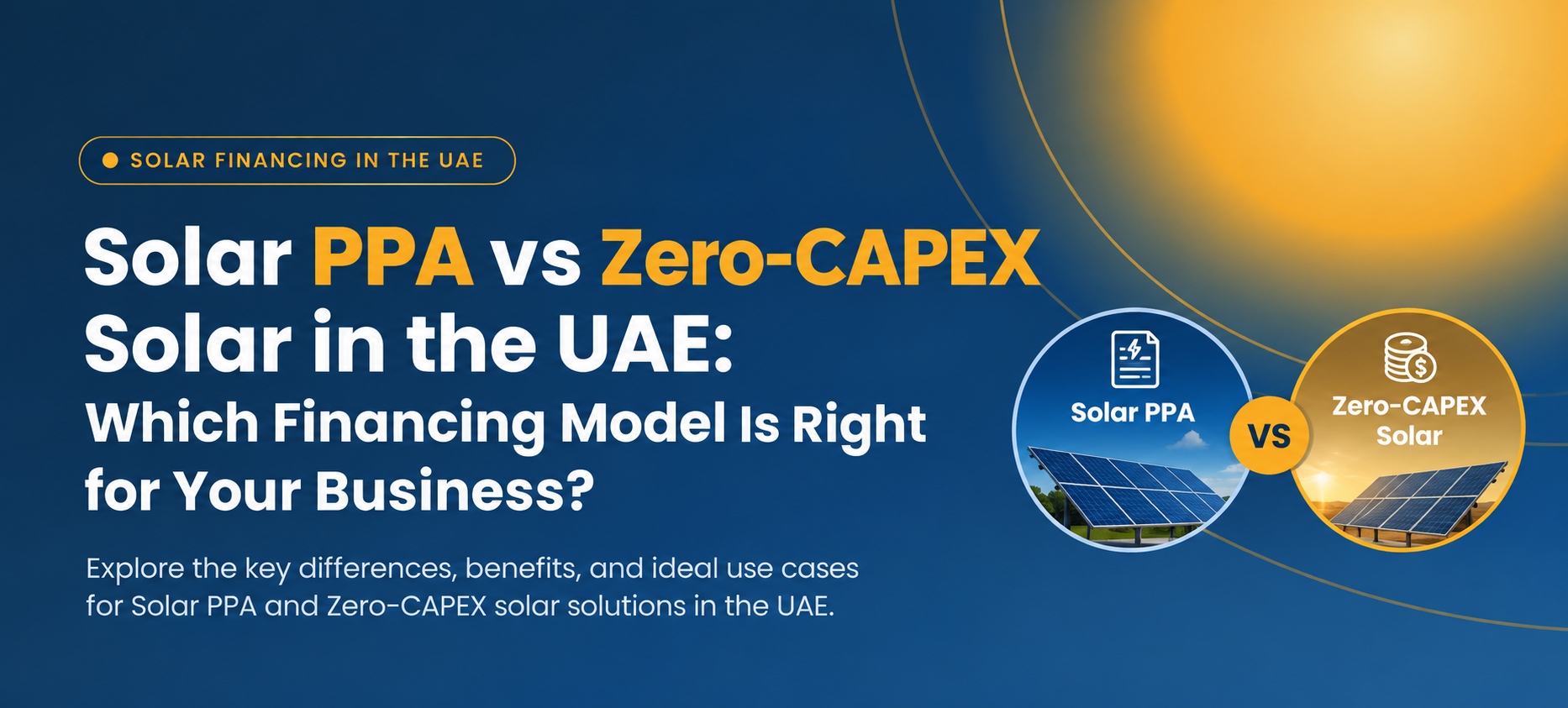
This is where solar financing models such as Power Purchase Agreements (PPAs) and zero-CAPEX solar can become relevant.
Both approaches are designed to reduce the importance of a large upfront payment, but they are not necessarily structured in exactly the same way. The commercial terms, ownership arrangements, energy pricing, contract duration, maintenance responsibilities, and end-of-contract options can vary from one project to another.
For businesses considering solar PPA services in the UAE, understanding those differences is an important first step.
What Is a Solar PPA?
A Power Purchase Agreement, commonly called a PPA, is a contractual arrangement in which a business agrees to purchase electricity generated by a solar system under agreed commercial terms.
In a typical structure, a solar project is developed and financed by a third party, while the business uses the electricity produced by the system. Instead of purchasing the entire solar installation upfront, the customer pays according to the agreed energy arrangement.
The exact structure depends on the project and contract. Important terms can include:
- Electricity price or tariff structure
- Contract duration
- System ownership
- Operations and maintenance responsibilities
- Performance requirements
- Insurance and other project responsibilities
- End-of-contract ownership or removal provisions
For a business, the main attraction of a PPA can be the ability to access solar-generated electricity without necessarily purchasing the entire project at the beginning.
What Does Zero-CAPEX Solar Mean?
Zero-CAPEX solar refers to solar arrangements designed to minimize or eliminate the customer’s upfront capital expenditure for the installation.
The phrase describes a financing or commercial approach rather than one single standardized contract. Depending on the provider and project, a zero-CAPEX structure may involve third-party ownership, a PPA, leasing, or another financing arrangement.
This distinction matters because two companies may advertise a zero-CAPEX solar solution while offering different commercial terms.
Businesses should therefore look beyond the phrase “zero CAPEX” and examine what they are actually agreeing to.
Before signing, ask:
- Who owns the solar system?
- Who pays for installation?
- Who is responsible for maintenance?
- How is the energy charge calculated?
- How long is the agreement?
- What happens if the property is sold or leased?
- What happens when the agreement ends?
- Are there escalation clauses?
- Are there minimum purchase commitments?
- What happens if the system produces less energy than expected?
Solar PPA vs Zero-CAPEX Solar: What Is the Difference?
The terms can overlap, which is why businesses should compare the underlying contract rather than relying only on the label.
| Consideration | Solar PPA | Zero-CAPEX Solar |
| Upfront capital | Generally designed to reduce the need for upfront project investment | Designed to minimize or avoid customer CAPEX |
| Payment structure | Often linked to electricity generated or purchased | Depends on the financing structure |
| System ownership | Depends on agreement | Depends on agreement |
| Maintenance | Defined contractually | Defined contractually |
| Contract length | Project-specific | Project-specific |
| Main focus | Purchasing solar-generated electricity | Accessing solar without a major upfront investment |
| Important review point | Energy price and contract terms | Total commercial structure and ownership terms |
The key point is that zero-CAPEX is not necessarily a completely separate technology or solar system. It describes how the project is funded and paid for.
A PPA can therefore be one possible form of a zero-CAPEX arrangement, depending on how the project is structured.
Why Are Financing Models Important for UAE Businesses?
Solar projects can involve several cost categories beyond the panels themselves. A commercial installation may include engineering, system design, inverters, mounting equipment, electrical work, monitoring, commissioning, maintenance, and other project-related expenses.
For a business, the financing decision should therefore be considered alongside the technical design.
LIT Energy’s website presents solar solutions for commercial and industrial applications, including customized systems and large-scale installations. Its commercial solutions focus on designing and implementing systems according to business energy requirements.
This means the financing discussion should ideally begin with the actual energy profile of the site rather than with a financing label alone.
When Could a Solar PPA Make Sense?
A PPA may be worth evaluating when a business wants to use solar-generated electricity while avoiding ownership of the entire solar asset from day one.
This can be particularly relevant for companies that:
- Prefer predictable contractual energy arrangements
- Want to preserve capital for their core business
- Have a suitable commercial or industrial property
- Have consistent electricity demand
- Want a third party to handle certain project responsibilities
- Are comfortable with a longer contractual commitment
However, a PPA is a long-term commercial agreement. Businesses should carefully review the pricing mechanism and contractual obligations rather than evaluating the arrangement solely on the basis of having no large upfront payment.
When Could Zero-CAPEX Solar Be Considered?
Zero-CAPEX solar may be attractive to businesses whose primary concern is the initial investment required for a solar installation.
For example, a company may have a suitable warehouse, office, manufacturing facility, or commercial property but prefer not to allocate significant capital to an energy project.
A zero-CAPEX structure can allow the business to consider solar while keeping the project’s financing structure separate from a conventional outright purchase.
The important question is not simply whether the initial CAPEX is zero. The business should calculate the complete financial commitment over the agreement period.
Compare the Total Cost, Not Just the Upfront Cost
One of the most common mistakes when comparing solar financing options is focusing only on the amount paid at the beginning.
A more useful comparison considers the entire financial picture.
Review:
1. Energy price
Understand how much the business will pay for solar electricity and whether that price changes during the contract.
2. Contract duration
A longer agreement may provide a different payment profile from a shorter arrangement. Consider whether the contract matches the property’s expected occupancy period.
3. Escalation clauses
Check whether the energy price or payment changes over time and understand how those changes affect the total cost.
4. Maintenance responsibilities
Confirm who is responsible for system monitoring, maintenance, repairs, replacements, and other operational requirements.
5. Ownership
Ownership can affect the financial treatment and end-of-contract options. Make sure the agreement clearly states who owns the equipment during and after the contract.
6. Property considerations
If the business leases its premises, review what happens if the lease ends before the solar agreement.
7. Exit conditions
Understand the commercial consequences of early termination, property sale, relocation, or business restructuring.
Solar PPA and Solar EPC Are Not the Same Thing
It is also important not to confuse financing with project delivery.
An EPC arrangement generally relates to engineering, procurement, and construction of the solar project, while a PPA relates to the commercial arrangement for purchasing electricity.
Businesses evaluating both concepts can explore the distinction in LIT Energy’s article about solar EPC vs PPA in the UAE.
A project can therefore involve technical delivery through an EPC structure while having a separate financing or electricity-purchase arrangement.
Understanding this distinction makes it easier to compare proposals from different solar providers.
The Solar Equipment Still Matters
Financing does not remove the importance of the underlying solar system.
The panels, inverter, mounting structure, electrical design, monitoring system, and installation quality all influence the project.
For example, businesses comparing commercial solar equipment can review Stellar 2N+78 Dual-Glass solar panels as part of LIT Energy’s listed solar panel range. The company also lists several other solar panel configurations and energy technologies for different applications.
The right equipment should be selected based on the project’s energy demand, available installation area, system design, operating conditions, and financial objectives.
How to Choose Between PPA and Zero-CAPEX Solar
Instead of asking which model is universally better, businesses should compare each option against their own requirements.
Start with these questions:
How much electricity does the site consume?
Review monthly and annual electricity consumption and identify the site’s daytime load.
How long will the business use the property?
A long-term financing arrangement should be compatible with the expected property and business plans.
Does the company want to own the system?
Some businesses prefer asset ownership, while others prefer an arrangement where another party owns and manages the system.
How important is preserving capital?
Companies with competing capital priorities may place greater importance on reducing upfront expenditure.
What level of operational responsibility does the business want?
Clarify whether maintenance, monitoring, repairs, and system management are included.
What is the total contractual cost?
Compare the complete financial commitment rather than only the starting price.
Consider the Solar System’s Operating Design Too
Financing is only one part of the decision.
Businesses should also consider whether they need a conventional on-grid configuration, hybrid capability, or another system design.
For example, an on-grid solar system is designed to work alongside the electricity grid, while a hybrid configuration can combine solar generation, battery storage, and grid electricity. LIT Energy describes its hybrid solutions as combining solar, battery backup, and grid connectivity.
Businesses comparing these technical approaches can also review LIT Energy’s guide to hybrid vs on-grid inverters before finalizing the project structure.
Common Mistakes When Comparing Solar Financing
Businesses should avoid making a decision based on a single headline number.
Common mistakes include:
- Comparing monthly payments without checking contract duration
- Ignoring escalation clauses
- Assuming every zero-CAPEX model has the same structure
- Not checking ownership terms
- Overlooking maintenance responsibilities
- Failing to review early termination conditions
- Choosing financing before understanding actual electricity consumption
- Comparing different solar system specifications as though they were identical
A properly structured comparison should consider technical, commercial, and operational factors together.
Which is better for a UAE business: a solar PPA or zero-CAPEX solar?
Neither model is automatically suitable for every business. A solar PPA is a contractual arrangement for purchasing solar-generated electricity, while zero-CAPEX describes a financing approach designed to minimize upfront customer investment. The right option depends on ownership preferences, energy pricing, contract terms, property tenure, maintenance responsibilities, and the business’s long-term financial objectives.
FAQs
1: What is a solar PPA in the UAE?
A solar PPA is an agreement under which a business purchases electricity generated by a solar project under defined contractual terms. The exact pricing, ownership, maintenance, and contract conditions depend on the agreement.
2: Is zero-CAPEX solar the same as a PPA?
Not necessarily. Zero-CAPEX describes a financing approach intended to avoid or minimize upfront capital expenditure. A PPA can be used as part of a zero-CAPEX structure, but other arrangements may also be possible.
3: Does zero-CAPEX solar mean the solar system is free?
No. Zero-CAPEX generally refers to the absence or reduction of upfront capital expenditure. The business may still make payments through an energy purchase, lease, financing arrangement, or another contractual structure.
4: What should businesses check before signing a solar PPA?
Businesses should review the energy price, contract duration, escalation mechanism, ownership, maintenance responsibilities, performance provisions, early termination terms, and what happens when the agreement ends.
5: Can a commercial property use solar without buying the system outright?
Yes, depending on the available financing structure and project terms. PPAs and other third-party financing arrangements can allow businesses to access solar without purchasing the entire system upfront.
6: What equipment is used in a commercial solar project?
A commercial solar project can include PV modules, inverters, mounting structures, electrical equipment, monitoring systems, and, where required, battery storage. The final configuration depends on the site’s energy requirements and system design.
Conclusion
For UAE businesses, choosing a solar financing model requires more than comparing upfront costs. A solar PPA and a zero-CAPEX structure can both reduce the importance of a large initial investment, but the underlying contracts can be significantly different.
The most useful approach is to evaluate the complete commercial arrangement alongside the technical solar design. Energy consumption, property tenure, ownership, electricity pricing, maintenance, contract duration, and exit conditions should all be considered before a business commits to a financing model.
LIT Energy LLC provides solar products and commercial and industrial solar solutions in the UAE, giving businesses a starting point for evaluating both the technical and energy requirements of a project.
For businesses researching solar financing in the UAE, the goal should be to find a structure whose commercial terms, technical design, and long-term obligations align with the way the business actually uses energy.