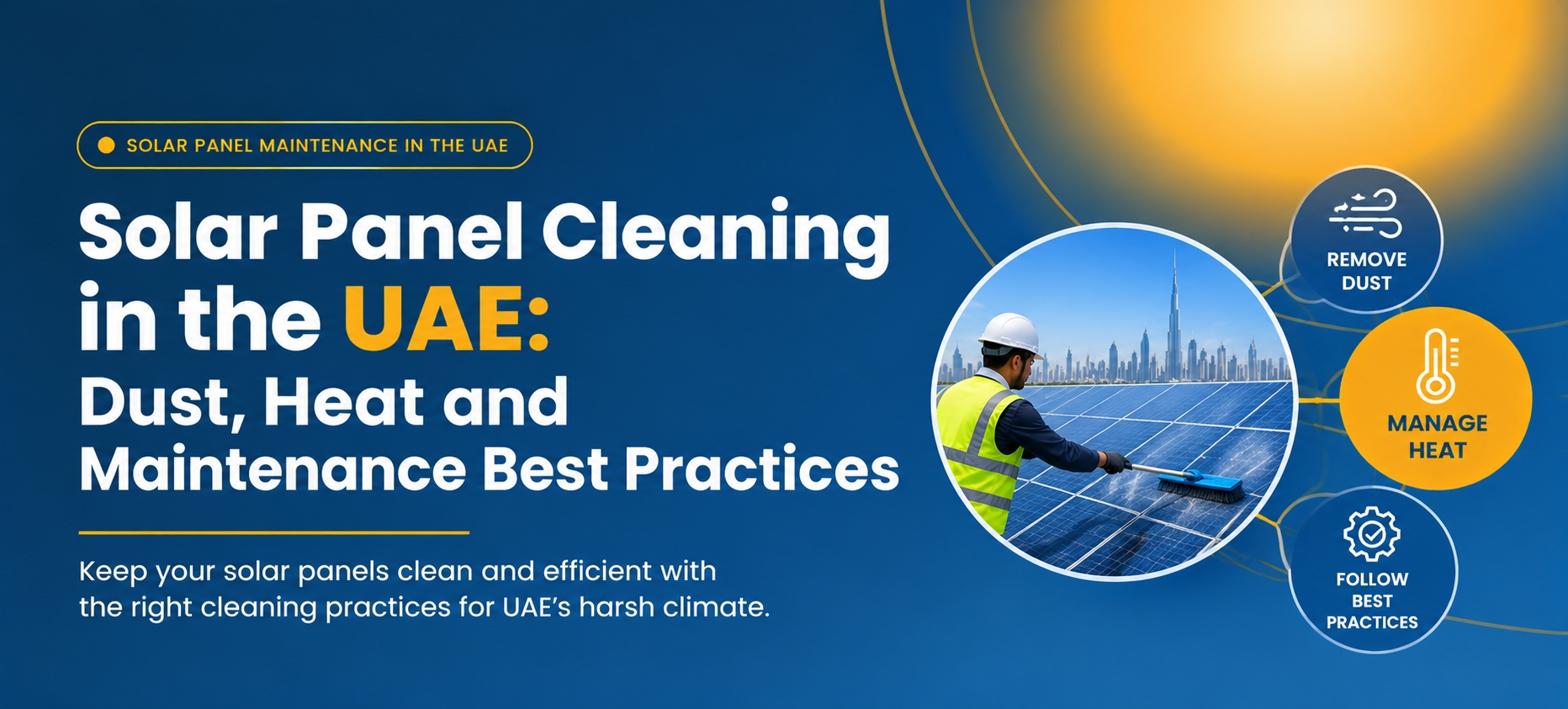
The UAE receives abundant sunshine throughout the year, making it an excellent location for solar energy generation. However, the same desert environment that supports solar power also creates maintenance challenges. Dust, sandstorms, high temperatures, and limited rainfall can affect solar panel performance over time.
One of the most common challenges is dust accumulation on solar panels. Even a thin layer of dust can reduce the amount of sunlight reaching photovoltaic (PV) cells, affecting electricity generation. Without proper cleaning and maintenance, these losses can gradually impact the overall performance of a solar installation.
For homeowners, commercial buildings, factories, and solar plant operators, regular solar panel cleaning is an essential part of system maintenance.
But how often should solar panels be cleaned in the UAE? Which cleaning methods are safe? And how can property owners maintain solar panel efficiency without wasting water or damaging the modules?
This guide covers the practical solar panel cleaning and maintenance best practices suited to the UAE’s desert climate.
1. Why Is Solar Panel Cleaning Important in the UAE?
Solar panels generate electricity by converting sunlight into electrical energy. For this process to work efficiently, sunlight must reach the photovoltaic cells through the protective glass covering.
In the UAE, airborne dust and sand gradually settle on panel surfaces. Construction activity, industrial emissions, bird droppings, and environmental pollutants can add to the accumulation.
This condition is known as solar panel soiling.
When dust covers the module surface, it reduces incoming sunlight and can lower electricity generation. The extent of the loss depends on dust composition, accumulation rate, panel tilt, humidity, and cleaning frequency.
Research conducted by the United Arab Emirates University found that panels left dusty for three months experienced up to 13% power loss compared with frequently cleaned panels under the study conditions.
The research also identified a 15-day cleaning interval as a practical balance between cleaning expenses and energy losses in that particular experiment.
These findings demonstrate why solar panel cleaning deserves attention in the UAE, particularly for installations exposed to frequent dust accumulation.
2. How Do Dust, Sand and Heat Affect Solar Panels?
The UAE’s environmental conditions affect solar installations in several ways.
Dust and Sand Accumulation
Dust particles settle on the glass surface and reduce the sunlight reaching solar cells. Fine particles can also combine with moisture, making accumulated dirt harder to remove.
After sandstorms, thicker deposits may form, requiring additional cleaning.
High Temperatures
High ambient temperatures increase solar module operating temperatures. Most conventional photovoltaic modules experience reduced electrical output as their cell temperature rises above standard test conditions.
Dust accumulation can create an additional performance challenge by restricting sunlight transmission.
Cleaning removes surface contamination, but it does not eliminate temperature-related efficiency losses. Proper ventilation, suitable equipment selection, and system design are also important.
Bird Droppings and Stubborn Deposits
Bird droppings can create localised shading that affects individual cells and, depending on the module and system design, may contribute to hot spots.
Unlike loose dust, these deposits may require careful removal using manufacturer-approved cleaning methods.
Limited Rainfall
Rain can remove some loose dust, but it is not a reliable replacement for planned cleaning in the UAE.
Dry periods allow dust to accumulate, while moisture can cause particles to adhere more strongly to the glass.
3. How Often Should Solar Panels Be Cleaned in the UAE?
There is no universal cleaning schedule for every solar installation. The ideal frequency depends on the property’s location, surrounding environment, panel angle, electricity generation patterns, and cleaning costs.
Research provides useful guidance.
A 2020 study published by researchers at United Arab Emirates University examined solar panel cleaning frequencies under Al Ain’s desert conditions.
Its findings included:
- Panels left dusty for 10 days experienced approximately 3% power loss.
- Panels left dusty for 20 days experienced approximately 5% power loss.
- Panels left dusty for 30 days experienced approximately 7% power loss.
- Panels left dusty for three months experienced up to 13% power loss.
The study identified approximately 15 days as a practical cleaning interval for its experimental conditions.
However, a 2024 study examining cleaning schedules in Abu Dhabi identified an economically optimal interval of approximately 34 days under its model assumptions.
The difference demonstrates why cleaning schedules should be based on local conditions rather than a fixed industry-wide recommendation.
Recommended Cleaning Approach
| Installation environment | Recommended approach |
| Residential rooftops | Inspect regularly and adjust cleaning based on dust accumulation and performance |
| Commercial buildings | Establish a scheduled cleaning and monitoring programme |
| Industrial facilities | Monitor dust exposure and increase inspections near industrial activity |
| Agricultural installations | Account for soil, irrigation residue, and surrounding agricultural dust |
| Utility-scale solar plants | Use performance monitoring and soiling measurements to optimise cleaning |
After sandstorms or periods of unusually heavy dust, inspect the modules and clean them when necessary.
For larger installations, performance monitoring and soiling measurements can help determine when cleaning provides a worthwhile energy recovery.
4. Best Solar Panel Cleaning Methods for UAE Conditions
Choosing the correct cleaning method is essential. An unsuitable brush, cleaning chemical, or water source can damage the protective glass or its surface coating.
A. Water-Based Cleaning
Water-based cleaning is commonly used to remove loose dust and surface deposits.
Where recommended by the panel manufacturer, clean water can be applied using suitable low-pressure equipment.
Deionised or reverse-osmosis (RO) water can help minimise mineral deposits and water spots after drying.
Avoid sudden temperature differences between cleaning water and hot module surfaces.
B. Soft Microfiber Brushes
Soft microfiber brushes or manufacturer-approved cleaning tools can help remove dirt without unnecessary abrasion.
They should be used gently, without excessive pressure.
C. Automated Solar Panel Cleaning Systems
Large commercial and industrial installations may benefit from automated cleaning equipment.
These systems can reduce manual labour and support scheduled maintenance across extensive solar arrays.
However, the cleaning equipment must be compatible with the panel surface and mounting arrangement.
D. Dry Cleaning Methods
Waterless cleaning technologies can be useful in desert environments where water conservation is a priority.
However, dry cleaning requires particular care. Sand particles trapped between brushes and the glass can cause abrasion and scratches.
The International Energy Agency’s PVPS research highlights the potential for abrasive damage when dry brushes interact with contaminated module surfaces.
The appropriate method should therefore depend on the type of contamination, cleaning technology, and manufacturer recommendations.
5. Step-by-Step Solar Panel Cleaning Best Practices
Following a consistent cleaning procedure helps maintain panel performance while reducing the risk of damage.
Step 1: Inspect the Solar Panels
Before cleaning, check for visible dust accumulation, bird droppings, stains, cracks, loose components, and damaged cables.
Identify any areas requiring specialist attention.
Step 2: Choose the Right Time
Avoid cleaning panels during peak daytime heat.
Early morning or late afternoon, when module temperatures are lower, is generally more suitable. Follow the manufacturer’s temperature and cleaning recommendations.
Cleaning water should be reasonably close to the module’s temperature to reduce thermal shock.
Step 3: Use Suitable Water
Use clean water with low mineral content where specified by the manufacturer.
Avoid water containing excessive dissolved minerals that can leave deposits after drying.
Step 4: Remove Loose Dirt Carefully
Use an approved soft brush or suitable low-pressure cleaning equipment.
Do not scrub dry sand aggressively across the glass surface.
Step 5: Remove Stubborn Deposits
For bird droppings and other stubborn contamination, use a manufacturer-approved cleaning method.
Avoid abrasive pads, harsh detergents, and strong chemicals.
Step 6: Check the Panels After Cleaning
Inspect the cleaned surface for remaining deposits, water marks, scratches, or other visible defects.
Where practical, compare electricity generation before and after cleaning under similar operating conditions.
Safety reminder: Rooftop solar cleaning involves electrical and fall hazards. PV modules can generate DC electricity whenever exposed to sunlight. Electrical isolation and cleaning procedures must follow the manufacturer’s instructions and be handled by trained personnel. Never walk on solar panels.
6. Common Solar Panel Cleaning Mistakes to Avoid
Incorrect cleaning practices can cause more damage than the dust itself.
Avoid these common mistakes:
- Using hard brushes: They can scratch the protective glass or surface coatings.
- Cleaning during extreme heat: Sudden temperature differences can create thermal stress.
- Using harsh chemicals: Strong cleaning agents may damage module materials.
- Applying excessive water pressure: High-pressure cleaning can damage seals, connectors, or other components.
- Scrubbing dry sand: Abrasive particles can scratch the glass during cleaning.
- Ignoring manufacturer instructions: Different panel technologies may have specific cleaning requirements.
- Walking on panels: This can cause cell damage and create serious safety risks.
- Cleaning without monitoring performance: A regular cleaning schedule should be evaluated against actual energy generation and operating costs.
7. Solar Panel Maintenance Checklist for UAE Property Owners
Cleaning is only one part of maintaining a solar energy system. A complete maintenance programme should also cover electrical components, mounting structures, inverters, and system performance.
| Maintenance activity | What to check |
| Panel cleaning | Dust, sand, bird droppings and stains |
| Visual inspection | Cracks, scratches and visible damage |
| Mounting structure | Loose fasteners, corrosion and stability |
| Electrical connections | Cable condition and connector damage |
| Inverter inspection | Warning indicators, ventilation and operating temperature |
| Performance monitoring | Energy generation and unexpected drops |
| Safety inspection | Earthing, protection devices and cable routing |
| Maintenance records | Cleaning dates, inspections and performance changes |
For residential properties, regular visual inspections and performance checks can help identify issues early.
Commercial and industrial installations benefit from documented preventive maintenance schedules and periodic technical inspections.
8. Residential vs Commercial and Industrial Solar Panel Maintenance
Maintenance requirements vary depending on installation size and operating conditions.
Residential Solar Systems
Homeowners should pay attention to visible dust, bird droppings, and changes in electricity generation.
Roof access and electrical safety should always be considered before arranging cleaning.
Commercial Solar Installations
Commercial buildings often have larger rooftop installations with substantial daytime electricity consumption.
A structured cleaning programme can help maintain generation and reduce avoidable performance losses.
Industrial Solar Installations
Factories and warehouses may experience additional exposure to industrial dust, exhaust particles, and nearby construction activity.
These environments require closer monitoring and maintenance planning based on site conditions.
For larger projects, professional solar operations and maintenance (O&M) services can help coordinate cleaning, inspections, monitoring, and corrective maintenance.
9. Why Professional Solar O&M Matters
A solar installation requires more than occasional surface cleaning to maintain long-term performance.
Professional solar operations and maintenance can include:
- Scheduled panel cleaning
- Preventive electrical inspections
- Inverter performance checks
- Mounting structure inspections
- Generation monitoring and reporting
- Fault identification and corrective maintenance
- Maintenance documentation
For commercial and industrial solar projects, a structured O&M programme can help identify performance issues before they develop into larger operational problems.
LIT Energy provides solar energy solutions for residential, commercial, and industrial applications. Its solar services cover different project requirements, while its solar EPC solutions address project engineering, installation, and commissioning.
For ongoing maintenance requirements, property owners can contact LIT Energy to discuss suitable support for their installation.
Key Takeaways
- Dust and sand accumulation can reduce solar panel electricity generation in the UAE.
- High temperatures create additional performance challenges beyond surface contamination.
- Cleaning frequency should depend on location, dust exposure, panel performance, and maintenance economics.
- UAE research has identified different optimal cleaning intervals under different experimental and modelling conditions.
- Use manufacturer-approved cleaning equipment, suitable water, and non-abrasive methods.
- Avoid cleaning extremely hot panels and never walk on solar modules.
- Regular inspections, inverter checks, and performance monitoring are essential parts of solar maintenance.
- Professional O&M programmes can help maintain the long-term performance of residential, commercial, and industrial solar installations.
Conclusion
Solar panel cleaning is an important part of maintaining a solar energy system in the UAE. Dust, sand, high temperatures, and limited rainfall create environmental challenges that can affect electricity generation over time.
A well-planned maintenance routine should combine appropriate cleaning methods, regular inspections, and performance monitoring. Rather than following an identical cleaning schedule for every property, owners should consider their installation conditions and actual energy generation data.
For residential, commercial, and industrial solar installations, proper maintenance helps protect equipment, reduce avoidable performance losses, and support reliable long-term operation.
LIT Energy offers solar energy solutions designed for different applications across the UAE. If you are planning a solar installation or reviewing the maintenance requirements of an existing system, connect with the LIT Energy team to discuss your requirements.
Keep your solar investment performing at its best with the right maintenance approach.
Frequently Asked Questions
1. How often should solar panels be cleaned in the UAE?
Solar panels should be inspected regularly, with cleaning frequency based on dust accumulation, location, and electricity generation. UAE research has identified different practical intervals, including approximately 15 days in an Al Ain experiment and 34 days in an Abu Dhabi optimisation study. Neither should be treated as a universal schedule.
2. Does dust reduce solar panel efficiency?
Yes. Dust and sand accumulate on the glass surface and reduce the sunlight reaching photovoltaic cells. This can lower electricity generation, with the extent of the loss depending on the amount and type of contamination.
3. What is the best time to clean solar panels in the UAE?
Early morning or late afternoon is generally preferable because panel temperatures are usually lower than during peak daytime heat. Avoid cleaning very hot panels with significantly cooler water.
4. Can I clean solar panels with normal tap water?
Clean tap water may be suitable if its mineral content is acceptable under the panel manufacturer’s guidelines. RO or deionised water can help prevent mineral deposits and water spots after drying.
5. Can high-pressure water damage solar panels?
Yes. Excessive water pressure can damage seals, connectors, and other sensitive components. Use manufacturer-approved cleaning equipment and suitable pressure levels.
6. Does rain clean solar panels effectively?
Rain may remove some loose dust, but it does not reliably remove accumulated sand, bird droppings, or stubborn deposits. Regular inspection and cleaning may still be necessary in the UAE.
7. Can dirty solar panels cause a reduction in electricity generation?
Yes. Surface contamination reduces the amount of sunlight reaching the solar cells and can affect system output. Monitoring electricity generation can help identify potential soiling-related performance losses.
8. Why is professional solar panel maintenance important?
Professional maintenance helps identify dirt accumulation, damaged panels, electrical connection issues, inverter faults, and other performance problems. A structured maintenance programme supports safer operation and helps maintain long-term solar system performance.