Solar energy is becoming an increasingly practical solution for homes, businesses, factories, and agricultural facilities across the UAE. With abundant sunshine throughout the year, solar panels offer an opportunity to generate renewable electricity, manage energy costs, and reduce dependence on conventional power sources.
However, choosing solar panels is only the first step. The type of solar system determines how electricity is generated, stored, and supplied to your property.
The three main options are on-grid, off-grid, and hybrid solar systems. Each has different capabilities, installation requirements, and advantages.
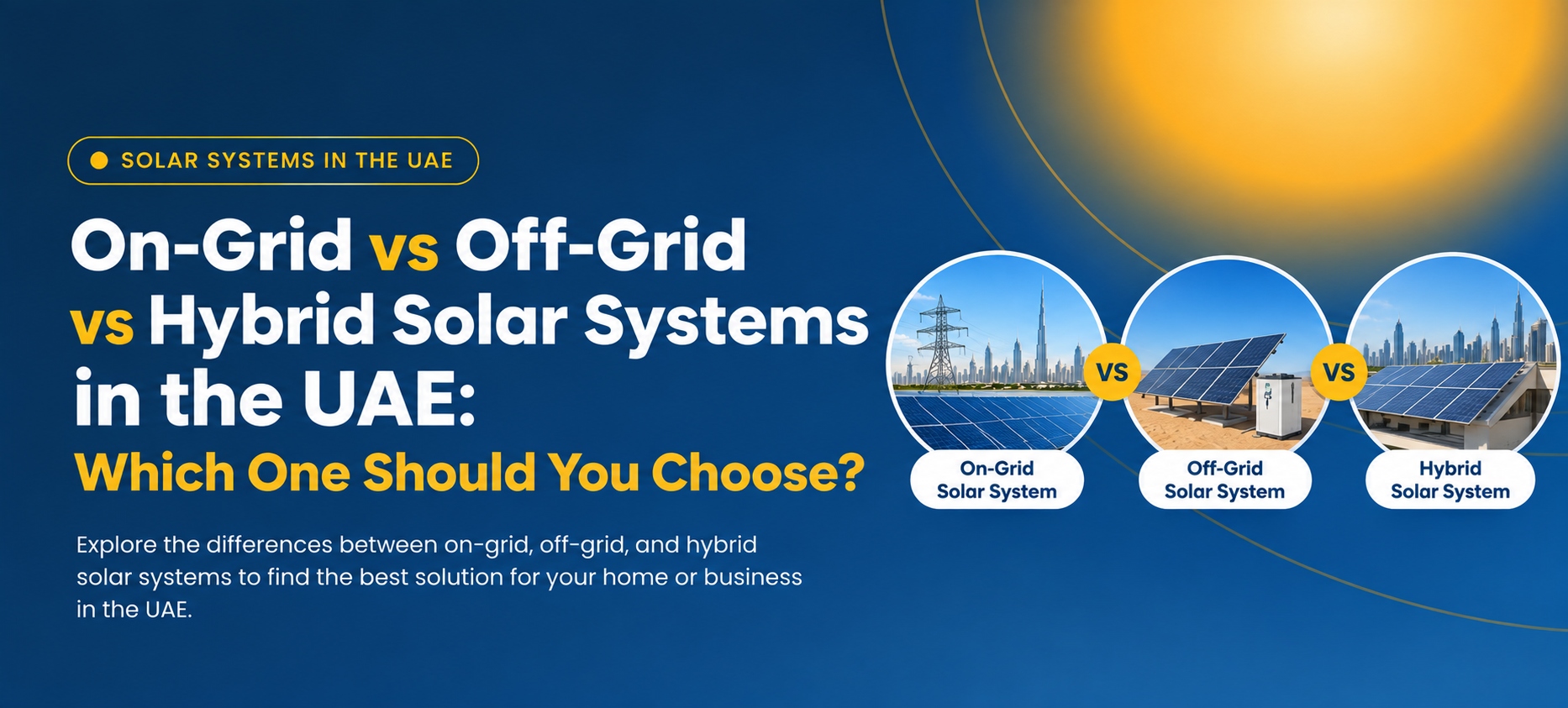
An on-grid system works alongside the utility network, an off-grid system operates independently using battery storage, and a hybrid system combines grid connectivity with battery backup.
Understanding these differences can help you select a solar solution that matches your property’s electricity consumption, location, and backup requirements.
1. What Is an On-Grid Solar System?
An on-grid solar system, also called a grid-connected solar system, connects directly to the local electricity network.
Solar panels convert sunlight into direct current (DC) electricity. A grid-tied inverter converts it into alternating current (AC), which powers appliances and equipment within the property.
When solar production exceeds immediate electricity consumption, surplus energy can be exported to the utility grid under the applicable regulations. When solar generation is insufficient, electricity is drawn from the grid.
How Does an On-Grid Solar System Work?
- Solar panels generate DC electricity from sunlight.
- The inverter converts DC electricity into usable AC electricity.
- Solar energy supplies the property’s electrical loads.
- Surplus electricity may be exported to the grid where permitted.
- Electricity is imported from the grid when solar generation is insufficient.
Benefits of On-Grid Solar Systems
- Lower initial investment: Batteries are generally not required.
- Reduced electricity bills: Solar generation offsets electricity purchased from the utility.
- Efficient energy utilisation: Surplus electricity may qualify for export credits under approved arrangements.
- Simpler installation: Fewer major components reduce system complexity.
- Lower maintenance requirements: No battery bank needs regular monitoring or eventual replacement.
Limitations
A standard on-grid system generally cannot supply electricity during a grid outage. Its inverter automatically disconnects from the utility network through anti-islanding protection to prevent unsafe electricity flow into the grid.
Best suited for: Grid-connected villas, offices, warehouses, commercial buildings, and factories primarily interested in reducing electricity costs.
Explore LIT Energy’s on-grid solar systems to understand available solutions.
2. What Is an Off-Grid Solar System?
An off-grid solar system operates independently of the electricity distribution network. It generates and stores electricity locally, allowing properties to function without a utility connection.
These systems are particularly useful for remote locations, agricultural facilities, isolated buildings, and areas where grid connectivity is unavailable or impractical.
Battery storage is essential because electricity must remain available when solar panels are not generating enough power.
How Does an Off-Grid Solar System Work?
An off-grid installation typically includes:
- Solar panels
- Off-grid inverter
- Solar charge controller or integrated MPPT
- Battery storage system
- Electrical protection and distribution equipment
During daylight hours, solar panels generate electricity for immediate use and battery charging. At night or during periods of insufficient sunlight, stored battery energy supplies the connected loads.
Benefits of Off-Grid Solar Systems
- Energy independence: No reliance on the main electricity grid.
- Remote accessibility: Suitable for farms, irrigation systems, and isolated facilities.
- Energy storage: Stores daytime solar generation for nighttime consumption.
- Reduced generator dependence: Can reduce conventional fuel consumption when appropriately designed.
- Flexible installation: Capacity can be configured according to specific energy requirements.
Limitations
Off-grid systems require careful sizing because there is no utility network to provide additional electricity when batteries are depleted.
The solar array and battery bank must support daily consumption, nighttime demand, and periods of reduced solar generation.
Battery replacement and additional storage requirements can also increase the total investment.
Best suited for: Remote properties, agricultural projects, irrigation facilities, and locations without practical grid access.
Explore LIT Energy’s off-grid solar solutions for independent solar power applications.
3. What Is a Hybrid Solar System?
A hybrid solar system combines solar panels, battery storage, and electricity grid connectivity.
It provides the energy-saving benefits of a grid-connected installation while offering battery backup when configured with suitable backup functionality.
During the day, solar electricity powers the property and charges the batteries. Additional surplus electricity may be exported to the grid when permitted.
At night or during a grid interruption, the system can use stored battery energy to supply designated electrical loads.
How Does a Hybrid Solar System Work?
- Solar panels generate electricity during daylight hours.
- The hybrid inverter manages solar, battery, and grid electricity.
- Solar energy supplies connected appliances and equipment.
- Excess generation charges the battery.
- Remaining surplus may be exported where approved.
- Stored battery energy supplies supported loads during nighttime or grid interruptions.
Benefits of Hybrid Solar Systems
- Battery backup: Supports selected electrical loads during grid interruptions.
- Flexible energy management: Coordinates solar, battery, and grid electricity.
- Greater energy resilience: Reduces dependence on grid electricity for supported loads.
- Better solar utilisation: Stores excess generation for later use.
- Expandable configurations: Additional battery capacity may be possible with compatible equipment.
Limitations
Hybrid systems generally require a higher initial investment because they include battery storage and more advanced inverter technology.
Battery capacity, backup duration, inverter output, and connected circuits must be carefully planned. Not every hybrid installation automatically provides backup to the entire property.
Best suited for: Villas, commercial buildings, and businesses that want to reduce electricity costs while maintaining backup power for essential equipment.
Discover LIT Energy’s hybrid solar systems and hybrid inverter solutions.
4. On-Grid vs Off-Grid vs Hybrid Solar Systems: Key Differences
The main differences involve grid connectivity, battery requirements, backup capabilities, and installation costs.
| Comparison Factor | On-Grid | Off-Grid | Hybrid |
| Grid connection | Yes | No | Yes |
| Battery storage | Not normally required | Essential | Usually included |
| Backup during outages | No, standard configuration | Yes, battery-based | Yes, if configured |
| Surplus solar energy | May be exported | Stored or managed locally | Stored or exported where permitted |
| Initial investment | Generally lowest | Generally higher | Generally higher |
| Energy independence | Limited | High | Partial to high |
| Utility dependence | Yes | No | Yes, when needed |
| Ideal application | Grid-connected properties | Remote locations | Properties needing backup |
Actual costs and capabilities depend on system capacity, equipment, battery configuration, installation conditions, and local utility requirements.
5. What Happens During a Power Outage?
Power backup is one of the most important considerations when selecting a solar system.
Many property owners assume solar panels will continue supplying electricity whenever sunlight is available. However, standard grid-connected systems generally shut down when the utility supply fails.
Here is how each configuration responds:
- On-grid: The standard grid-tied inverter disconnects during an outage because of anti-islanding protection.
- Off-grid: The system continues supplying electricity from its battery, provided sufficient stored energy is available.
- Hybrid: A properly configured system can disconnect from the grid and supply designated backup circuits using battery power and available solar generation.
For example, a UAE villa owner may want to keep refrigerators, lighting, internet equipment, and selected air-conditioning units operational during an interruption.
A hybrid system can be designed around these priority loads instead of attempting to power every appliance simultaneously.
6. Which Solar System Is Best for Homes in the UAE?
The right choice depends on electricity consumption, grid availability, and backup requirements.
On-Grid Solar for Residential Properties
For villas and homes with reliable electricity connections, on-grid solar can be a practical option when the main objective is reducing electricity bills.
Properties with substantial daytime air-conditioning and household electricity consumption can directly use a significant portion of their solar generation.
Learn more about LIT Energy’s residential and solar energy solutions.
Hybrid Solar for Homes Requiring Backup
Homeowners who want electricity during grid interruptions may benefit from a hybrid system.
The battery should be sized according to essential appliance consumption, expected backup duration, and inverter capacity.
Off-Grid Solar for Remote Properties
Off-grid systems are suitable for properties without practical utility access. Their design must account for daytime and nighttime consumption, battery capacity, and periods of reduced solar generation.
For most grid-connected urban homes, disconnecting completely from the utility network is not necessary to benefit from solar energy.
7. Which Solar System Is Suitable for Commercial and Industrial Properties?
Commercial and industrial facilities often have more complex electricity requirements than residential buildings. System selection should consider operating schedules, equipment loads, peak demand, and the financial impact of interruptions.
On-grid systems for commercial buildings
Offices, warehouses, and commercial facilities with substantial daytime consumption can use on-grid solar to offset electricity purchased from the utility without the additional cost of battery storage.
Hybrid systems for critical operations
Hybrid configurations can support selected loads such as:
- Security and surveillance systems
- IT infrastructure and networking
- Emergency lighting
- Monitoring and control equipment
- Selected operational machinery
Off-grid systems for agricultural facilities
Remote farms and irrigation facilities may benefit from off-grid installations where grid connectivity is unavailable or uneconomical.
The design should account for pump operating hours, motor starting requirements, water storage, and seasonal electricity demand.
Explore LIT Energy’s commercial and industrial solar services for different project applications.
8. Solar System Costs and Important Considerations in the UAE
Solar installation costs depend on more than the number of panels. System capacity, inverter technology, battery requirements, electrical infrastructure, and installation complexity all influence the final investment.
Important cost factors include:
- Solar panel capacity: The installed capacity, measured in kilowatts-peak (kWp), determines the system’s rated DC generation capacity.
- Inverter technology: Grid-tied, off-grid, and hybrid inverters have different capabilities and technical requirements.
- Battery storage: Hybrid and off-grid systems require battery capacity suited to their energy and backup requirements.
- Installation complexity: Roof conditions, cable routing, mounting structures, and electrical upgrades affect costs.
- Utility approvals: Grid-connected systems must satisfy the relevant electricity authority’s requirements.
Is Battery Storage Worth the Additional Investment?
Not always.
Battery storage is valuable when backup electricity is necessary or when using stored solar energy outside daylight hours provides a financial or operational benefit.
However, a property with substantial daytime consumption may achieve better project economics with an on-grid system without batteries.
The decision should consider electricity tariffs, export-credit arrangements, battery replacement costs, and long-term energy requirements.
9. Important Solar Installation Considerations in the UAE
The UAE’s environmental and regulatory conditions should be considered before installing a solar power system.
High Temperatures
Solar panels, inverters, and batteries must be selected according to their operating temperature specifications.
Inverters and batteries should be installed in suitable locations with appropriate ventilation and thermal management.
Dust and Sand Accumulation
Dust accumulation can reduce solar panel generation. A maintenance plan should account for local environmental conditions and manufacturer cleaning recommendations.
Utility Approvals and Grid Connection
Grid-connected solar installations must comply with the relevant emirate’s technical and connection requirements.
In Dubai, the DEWA Shams Dubai programme regulates the connection of distributed solar PV systems to the electricity network.
DEWA’s solar PV FAQs provide guidance on equipment compliance, system suitability, and installation requirements.
Abu Dhabi has also introduced its Solar Energy Self-Supply Policy. In 2026, the Abu Dhabi Department of Energy expanded the policy to include residential properties, including eligible villas and residential buildings.
Requirements differ between emirates, so property owners should confirm the applicable regulations before installation.
Battery Compatibility and Safety
Hybrid and off-grid systems require compatible batteries, inverters, battery management systems, and electrical protection.
Lithium iron phosphate (LFP) batteries are commonly used for stationary energy storage. Selection should consider usable capacity, operating temperature, warranty, certifications, and inverter compatibility.
10. Common Mistakes to Avoid When Choosing a Solar System
A solar installation is a long-term investment. Avoiding common design mistakes can improve performance and prevent unnecessary costs.
- Choosing only by initial price: A low-cost system may not meet actual electricity requirements.
- Ignoring backup requirements: Standard on-grid systems generally cannot supply electricity during grid outages.
- Oversizing batteries: Excessive storage can increase costs without delivering meaningful additional value.
- Ignoring future electricity demand: EV charging, additional cooling, and business expansion can change consumption.
- Overlooking approvals: Grid-connected installations require relevant technical approvals.
- Neglecting maintenance: Dust, poor connections, and inadequate equipment ventilation can affect performance.
11. How to Choose the Right Solar System
Before selecting a solar configuration, assess five important factors:
- Grid availability: Does your property have a reliable utility connection?
- Electricity consumption: How much electricity do you use, and when is demand highest?
- Backup requirements: Do you need electricity during grid interruptions?
- Battery requirements: How much energy must be stored, and for how long?
- Financial objectives: Is your priority reducing electricity bills, increasing energy independence, or improving operational resilience?
A professional solar assessment should include electricity bills, load profiles, available installation space, electrical infrastructure, and future energy requirements.
The system should be designed around actual consumption rather than assumptions based on property size.
12. Why Choose LIT Energy for Solar Energy Solutions in the UAE?
Selecting the right solar system requires more than choosing panels and an inverter. The complete solution must match the property’s energy requirements, environmental conditions, and operational objectives.
LIT Energy provides solar energy solutions covering on-grid, off-grid, and hybrid configurations, alongside solar inverters and energy storage technologies.
Its solutions address different residential, commercial, industrial, and specialised applications.
Explore LIT Energy’s solar solutions to learn more about available technologies and applications.
Key Takeaways
- On-grid solar systems connect to the utility network and generally offer a lower-cost way to reduce electricity bills.
- Off-grid solar systems operate independently and require sufficient battery storage.
- Hybrid solar systems combine grid connectivity with battery-based backup.
- Standard on-grid systems generally shut down during grid outages because of anti-islanding protection.
- Hybrid backup depends on inverter capacity, battery storage, and connected circuits.
- UAE installations must account for high temperatures, dust accumulation, and emirate-specific utility regulations.
- Professional system sizing is essential for long-term performance.
Conclusion
Choosing between on-grid, off-grid, and hybrid solar systems depends on how your property consumes electricity and what you expect from your solar investment.
An on-grid system can help reduce electricity costs when utility connectivity is available. An off-grid system provides energy independence for remote properties, while a hybrid system combines grid connectivity with battery storage and backup capabilities.
For UAE homeowners and businesses, the decision should consider energy consumption, backup requirements, installation conditions, battery economics, and local approval procedures.
LIT Energy offers solar energy solutions designed for different property and operational requirements.
Looking for the right solar system for your property in the UAE? Contact LIT Energy to discuss your requirements and explore a suitable solar solution.
Follow LIT Energy on LinkedIn for solar technology updates, company news, and energy solutions.
Frequently Asked Questions (FAQs)
1. What is the difference between on-grid, off-grid, and hybrid solar systems?
An on-grid solar system connects to the utility electricity network and generally does not require batteries. An off-grid system operates independently using battery storage, while a hybrid solar system combines grid connectivity with battery backup.
2. Which solar system is best for homes in the UAE?
On-grid solar systems are suitable for homes with reliable electricity connections that want to reduce electricity bills. Hybrid systems are ideal for homeowners who also need backup power, while off-grid systems are better suited to remote properties without grid access.
3. Does an on-grid solar system work during a power outage?
No. A standard on-grid solar inverter automatically disconnects during a grid outage because of anti-islanding protection. Additional compatible backup equipment is required to supply electricity during an interruption.
4. Is battery storage necessary for an off-grid solar system?
Yes. Battery storage is essential for most off-grid installations because it stores excess daytime solar energy for nighttime use and periods of insufficient sunlight. Battery capacity should match the property’s energy consumption and backup requirements.
5. Can a hybrid solar system work without grid electricity?
Yes. A properly configured hybrid solar system can operate using solar generation and stored battery energy when grid electricity is unavailable. Its backup capability depends on inverter specifications, battery capacity, and connected electrical loads.
6. Are hybrid solar systems worth the investment in the UAE?
Hybrid systems can be worthwhile for properties that require backup electricity and greater control over energy consumption. Their financial value depends on battery costs, electricity tariffs, energy usage patterns, and backup requirements.
7. Can solar panels power air conditioners in UAE homes?
Yes. Solar panels can power air-conditioning systems when the solar installation is correctly sized. The design should consider AC power consumption, operating hours, starting requirements, and other household electricity loads.
8. Do solar installations require approval in the UAE?
Yes. Grid-connected solar installations must comply with the relevant emirate’s electricity authority requirements. Dubai follows DEWA’s Shams Dubai programme, while Abu Dhabi has its own solar self-supply regulatory framework. Requirements should be confirmed before installation.