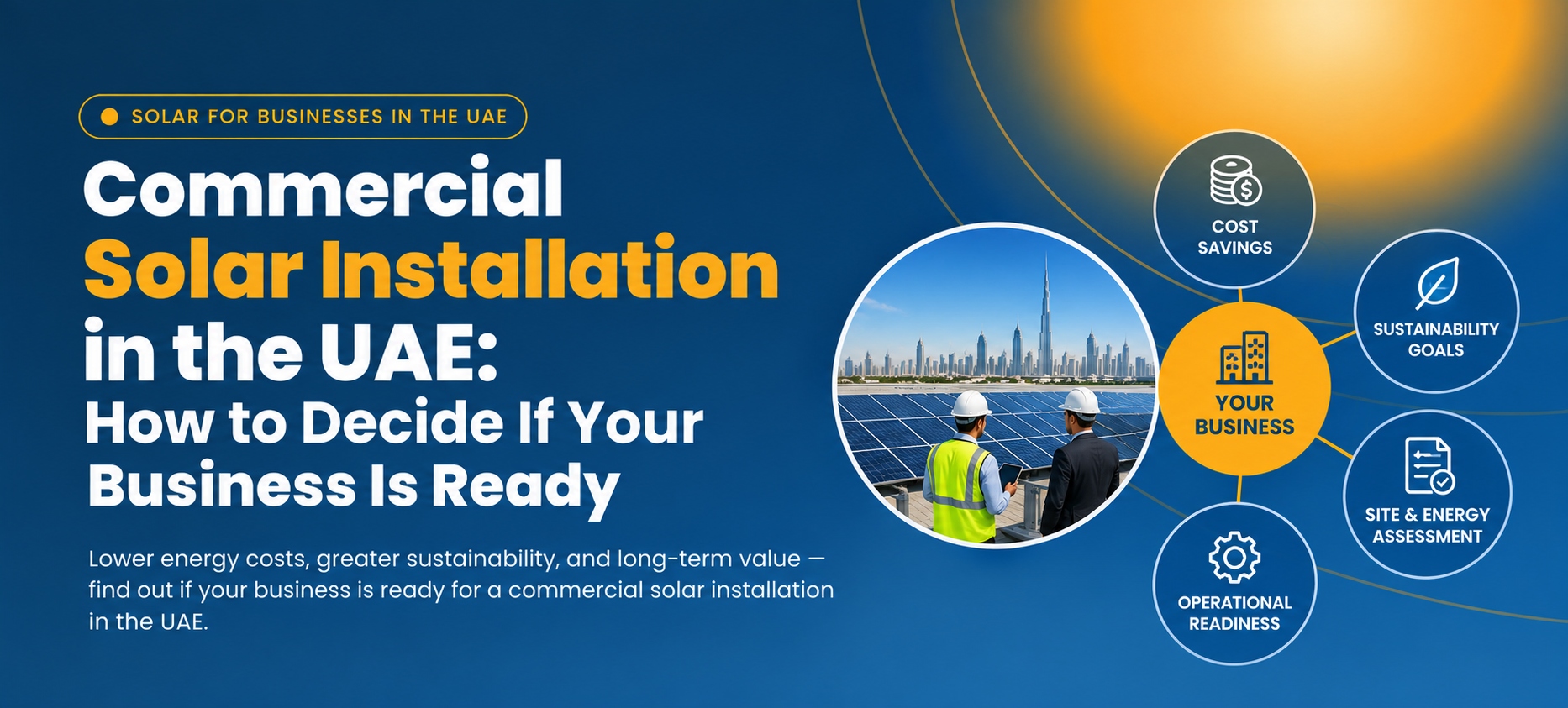
For many businesses in the UAE, electricity is a significant operating expense. Warehouses need lighting and ventilation, factories run machinery, offices rely on air conditioning, and retail facilities need consistent power throughout the day. When these demands continue year after year, installing solar panels can become worth investigating.
However, a large electricity bill alone does not mean a commercial solar project is automatically a good investment. The result depends on when a business consumes electricity, how much usable roof space it has, the condition of its building, applicable electricity tariffs, project costs, and the approvals required before installation.
A practical approach to commercial solar installation in the UAE starts with a feasibility assessment rather than an equipment quotation. Businesses should establish whether their site can accommodate a suitable system, whether solar generation matches their consumption, and whether the projected financial benefits justify the investment.
This guide explains how business owners, CFOs, and facility managers can make that decision using a straightforward go/no-go framework.
1. Start With Your Electricity Consumption Pattern
Before assessing roof space or comparing solar panels, examine how your business uses electricity.
A commercial solar system generates electricity during daylight hours. Its financial value therefore depends partly on how much of that electricity the building can use while the system is generating power.
For example, a manufacturing facility operating throughout the day may be able to use solar electricity directly for machinery, lighting, ventilation, and other equipment. A warehouse with daytime operations may also have a useful consumption profile.
A business that remains closed during much of the day may have a different result. Its solar generation could exceed immediate demand during certain periods, making the applicable rules for exporting surplus electricity particularly relevant.
What should you review?
Collect electricity bills and, where available, interval consumption data covering a representative operating period. Review:
- Monthly electricity consumption and expenditure.
- Typical weekday and weekend demand.
- Daytime versus evening electricity use.
- Seasonal changes in cooling and production requirements.
- Planned changes in equipment, production capacity, or operating hours.
A useful starting point is to compare hourly electricity demand with estimated hourly solar generation. This reveals whether a proposed system is likely to produce electricity when the business needs it.
Go: Daytime consumption is substantial and reasonably consistent.
Investigate further: Demand varies significantly, or much of the electricity is used after sunset.
No-go for the current design: The proposed system’s output would regularly exceed useful demand and the economics of surplus export do not justify the investment. A smaller system may still be viable.
2. Check Whether Your Roof Can Support a Commercial Solar System
A suitable roof is another essential consideration for a rooftop solar system in the UAE. Total roof area is only the starting point; the entire surface cannot necessarily accommodate solar modules.
Equipment rooms, access routes, skylights, shading, ventilation systems, and safety clearances can reduce the usable installation area. Nearby structures and rooftop equipment may also affect how the array should be positioned.
Roof condition and remaining lifespan
A structural assessment should establish whether the roof can accommodate the proposed installation and its associated loads. The review should consider the building’s construction, mounting method, waterproofing, wind exposure, and maintenance requirements.
Roof age matters as well. If major waterproofing or refurbishment work is approaching, completing that work before installing solar panels may prevent the expense and disruption of removing and reinstalling equipment later.
Businesses should also consider who owns the building. Tenants may need the landlord’s written consent, while shared buildings can involve additional coordination.
Go: The roof has sufficient usable space, its condition is suitable, and the required structural checks can be completed.
Investigate further: The roof needs repairs, shading is substantial, or ownership permissions remain unclear.
No-go for rooftop installation: The building cannot safely support the proposed arrangement and no practical alternative site is available.
3. Match Solar Capacity to Actual Business Demand
A larger solar array is not necessarily a better investment. The objective is to select a system that balances generation potential, on-site consumption, installation costs, and applicable connection requirements.
Commercial solar solutions in the UAE should be designed around the facility’s actual electricity profile rather than roof capacity alone.
For instance, a distribution centre may have a large roof but relatively modest daytime electricity demand. A factory with a smaller roof could have stronger daytime demand because of continuous production equipment.
The suitable system size can differ substantially between these buildings.
A feasibility assessment should consider:
- Estimated annual solar generation.
- Expected on-site electricity consumption from solar.
- Potential surplus generation.
- System losses and shading.
- Inverter capacity and electrical infrastructure.
- Applicable utility and building requirements.
The assessment should also account for future changes. If a facility plans to add machinery or extend operating hours, the design may need to reflect those plans. Future demand should be based on realistic business projections, not assumed growth.
For an initial technical review, businesses can explore LIT Energy’s solar EPC services, which cover project assessment, system design, equipment sourcing, installation, and commissioning.
4. Understand the Financial Case Before Approving the Project
The commercial decision should be based on expected financial performance, not a general promise of lower electricity bills.
Start by identifying the project’s full cost. Depending on the installation, this may include solar modules, inverters, mounting structures, electrical work, engineering, approvals, grid connection, monitoring, and any necessary roof repairs.
Next, estimate the financial value of the electricity the system is expected to generate.
A simplified calculation is:
Estimated annual net benefit = avoided electricity costs + eligible export benefits − annual operating and maintenance costs
The value of avoided electricity costs depends on the tariff components that actually change when grid consumption falls. Exported electricity should be valued according to the rules and commercial arrangements applicable to the specific project, rather than assuming every exported unit receives the same value as a unit consumed on-site.
The financial review should include realistic assumptions about system performance, degradation, maintenance, insurance where applicable, and future electricity costs.
Calculate simple payback carefully
Simple payback provides an initial comparison between project cost and annual net benefit.
For example, if a hypothetical system costs AED 300,000 and generates an estimated annual net benefit of AED 60,000, its simple payback would be five years.
These figures are illustrative only, not a quotation or an estimate of savings for a particular UAE business.
Simple payback also does not account fully for financing costs, changes in energy prices, equipment replacement, or the time value of money. For a more complete decision, finance teams should compare projected cash flows over the expected operating life of the system and test different assumptions.
Go: The financial model remains attractive under reasonable operating and cost assumptions.
Investigate further: The result depends heavily on optimistic generation, tariff, or export assumptions.
No-go: The projected benefits do not justify the investment, even after considering reasonable design adjustments or alternative financing arrangements.
5. Check Your Electricity Tariff and Local Approval Requirements
Solar feasibility is not determined by technology alone. The applicable electricity tariff and local utility rules can change the financial and technical design of a project.
Businesses should confirm which tariff components are affected by reduced grid consumption, whether demand-related charges apply, and how surplus generation is treated under the relevant arrangement.
They should also identify the authority responsible for approving the installation.
In Dubai, DEWA’s Shams Dubai programme provides a framework for connecting eligible building-based solar photovoltaic systems to the electricity network. DEWA describes a process involving the initial application and No Objection Certificate, design approval, inspection and connection, and generation. Building-related approvals and technical documentation may also be required.
Businesses can consult the official DEWA solar guidance for applicable requirements. Other emirates may have different utility procedures, so Dubai-specific rules should not be assumed to apply throughout the UAE.
Before committing to installation, confirm:
- Which utility and building authority has jurisdiction.
- Whether the proposed contractor and equipment meet applicable requirements.
- Which approvals and permits are necessary.
- Whether grid connection and export arrangements are permitted for the proposed design.
- What inspections and completion documents will be required.
Go: The approval pathway is understood and the proposed design can be developed to meet the relevant requirements.
Investigate further: The utility has not reviewed the proposed capacity, connection arrangement, or equipment eligibility.
No-go for now: A necessary approval cannot be obtained or a material regulatory constraint makes the proposed design unworkable.
6. Review Operating Hours, Maintenance and Business Continuity
Solar projects must work around the realities of operating a commercial facility.
Installation planning should account for production schedules, loading bays, roof access, employee safety, and any restrictions on working around existing electrical equipment. Factories and logistics facilities may need a phased installation plan to minimise disruption.
After commissioning, the system also requires monitoring and appropriate maintenance. Dust accumulation, equipment faults, inverter performance, and electrical issues can affect generation. The maintenance plan should specify inspection responsibilities, fault reporting, access arrangements, and relevant warranty terms.
Another point deserves attention: a standard grid-connected solar system does not automatically provide backup power during a grid outage. Backup capability depends on the system architecture, inverter configuration, battery storage where applicable, and the necessary electrical protections and approvals.
Businesses that require power for critical equipment should evaluate those requirements separately rather than assuming rooftop panels alone will maintain operations during an outage.
Go: Installation and maintenance can be managed without unacceptable disruption, and any backup requirements have been addressed.
Investigate further: Access, shutdowns, maintenance responsibilities, or backup expectations are unresolved.
7. Consider the Right Commercial Solar Solution
Once a site passes the initial checks, the next step is to compare technically suitable system designs and project delivery options.
LIT Energy offers commercial and industrial solar solutions, including solar project engineering, equipment procurement, installation, and commissioning through its solar EPC offering. Its commercial and industrial solar services provide a relevant starting point for businesses assessing their requirements.
The right approach depends on the facility and its objectives. A business may prioritise reducing daytime electricity purchases, improving energy-cost predictability, supporting sustainability reporting, or evaluating a larger industrial installation.
A proposal should explain the recommended capacity, expected generation, assumptions behind projected savings, equipment specifications, approval responsibilities, maintenance arrangements, and the exclusions that could affect the final cost.
Compare proposals on a consistent basis. A lower initial quotation is not necessarily the better choice if it relies on unrealistic production estimates, omits essential electrical work, or leaves important approval and maintenance responsibilities undefined.
8. A Practical Go/No-Go Checklist for Business Owners
Use the following checklist before moving from initial interest to a detailed feasibility study.
| Decision factor | Go | Investigate further |
| Electricity demand | Meaningful daytime consumption | Demand is mostly outside solar hours |
| Roof condition | Suitable structure and usable space | Repairs, shading, or structural checks needed |
| System sizing | Capacity matches demand and site constraints | Excess generation or capacity limits uncertain |
| Financial return | Conservative model supports investment | Payback depends on uncertain assumptions |
| Tariff and approvals | Applicable rules and approval pathway confirmed | Export terms or utility requirements unclear |
| Operations | Installation and maintenance are manageable | Disruption, access, or backup needs unresolved |
A business does not need to have every answer before beginning a feasibility study. However, it should resolve major structural, regulatory, and financial uncertainties before committing to a system design or signing an installation contract.
Conclusion: Is Commercial Solar Installation Right for Your UAE Business?
Commercial solar installation in the UAE is worth evaluating when a business has suitable installation space, meaningful daytime electricity demand, a workable approval pathway, and a financial case that holds up under realistic assumptions.
The best starting point is to gather electricity bills, consumption data, roof information, operating schedules, and any planned facility changes. These details allow a solar feasibility assessment to focus on the opportunities and constraints that matter to the business.
LIT Energy provides commercial and industrial solar solutions for businesses evaluating solar project options. If your organisation is considering a rooftop solar system, you can contact LIT Energy to discuss the site requirements and the next steps toward a project assessment.
The decision should ultimately rest on verified site conditions, applicable local requirements, and a transparent financial model—not on system size or projected savings alone.
Frequently Asked Questions
1: Is commercial solar installation worth it in the UAE?
It can be worthwhile for businesses with suitable roof space, significant daytime electricity demand, and favourable project economics. The outcome depends on installation cost, solar generation, electricity tariffs, self-consumption, maintenance, and applicable approval requirements.
2: Which businesses can benefit from a commercial rooftop solar system?
Factories, warehouses, offices, retail facilities, and other commercial buildings may be suitable candidates. Each site needs an assessment of its electricity consumption, roof condition, usable area, operating hours, and local utility requirements.
3: How do I determine the right solar system size for my business?
Review electricity consumption data alongside estimated solar generation, particularly during daylight hours. A feasibility assessment should consider usable roof space, shading, electrical infrastructure, system losses, future demand, and applicable connection limits.
4: What approvals are required for commercial solar installation in the UAE?
Requirements depend on the emirate, utility, building type, and proposed system. In Dubai, projects under the Shams Dubai framework involve utility application and design approval stages, followed by inspection and connection requirements. Businesses should verify current requirements with the relevant authorities before installation.
5: Will rooftop solar panels provide electricity during a grid outage?
Not necessarily. A standard grid-connected solar system generally does not provide backup power during an outage. Backup operation depends on suitable equipment, system configuration, battery storage where required, and applicable safety and connection requirements.
6: How can a business compare commercial solar installation proposals?
Compare total project cost, estimated annual generation, on-site consumption, financial assumptions, equipment specifications, warranties, approval responsibilities, maintenance arrangements, and exclusions. Use consistent assumptions across proposals so the comparison reflects the likely financial and operational outcome.